Wednesday, 19 June 2013

Books by Post!

Woo hoo! Every day this week the postman has delivered a book (or books), thanks to my lovely Mother, who gave me some money when I was staying with her last week, and told me to treat myself – so I bought novels which, hopefully, will be a treat to read, and I shall have them to enjoy for ever!

The problem, of course, is what to buy. I’m never any good at making decisions and I don’t whether to buy titles I know I love because I’ve borrowed them from the library or from friends, or whether to opt for new volumes on the wish list. And I was really tempted to splurge on some brand new Persephones, or to browse round Waterstones in Birmingham, or visit some other bookish town for the day and just see what takes my fancy.

Sadly there is no book shop in Tamworth. Can you imagine that? Even The Works (which isn’t a proper bookshop at all, though you can pick up the occasional goodie if you search hard), closed down. So, on the rare occasions I’m let loose in a book store and have cash to spare I’m like a child in a sweet shop and indulge in what can only be described as the literary equivalent of a deprived dieter’s binge eating session . 
Anyway, as I generally do, I plumped for second-hand rather than new, because it means the books are cheaper, and you get more of them! Shallow, I know, but I’ve always been attracted by quantity rather than quality, but whittling down that extensive wish list was well-nigh impossible – and my purchases haven’t made any impact on it all. I spent an evening trawling through Amazon and AbeBooks to see what was available, and in the end based my choices on the fact that books must be published by Persephone or Virago, and they should be ‘paired’  in some way. Well, it narrowed the field a bit...

So, what have I got? There’s a lovely Virago Modern Classic selection of short stories by Sylvia Townsend-Warner, which is in fabulous condition, and looks as if it has never been read. And I bought Mr Fortune’s Maggot AND I’d already spotted an old VMC of After The Death of Don Juan (not pictured) which I haven’t read yet so, as you can see, I’ve developed a bit of a passion for STW’s work. And I really want a copy of the letters between her and William Maxwell, and a decent biography – can anyone out there recommend one? Please!

There’s a nice copy of Angela Thirkell’s Wild Strawberries, because I enjoyed High Rising and Cheerfulness Breaks In so much, and to go with that Greenery Street by her brother Denis McKail, because it sounds as if I would like it, and at the moment I seem to be hooked on novels from the 20s and 30s. Surprisingly, the McKail arrived with its bookmark intact, which was very pleasing.
 I’ve had my open for Agnes Jekyll’s Kitchen Essays for ages, and I’ve already had a quick look through, and it’s quite enchanting. I love cookery books and people’s thoughts about food and ingredients. I paired it with Few Eggs and No Oranges, the wartime diaries of Vere Hodgson, because both authors seem to write from a very personal point of view.

Finally, I snapped up Miss Buncle’s Book, by DE Stevenson, which has been at the top of my wanted catalogue since I read Mrs Tim, plus I’m part-way into Amberwell, which was another Oxfam buy.
I’m quite pleased with my selection. I know I’ve played safe by choosing things I’m fairly sure I will like, and perhaps I should have been more adventurous, but I can try out new things at the library, and books are meant o be enjoyed, so what’s the point in buying something by an author I don’t usually like, or in genre I don’t connect with?
And I didn’t spend all my money – I’m spreading it out, so I have something to look forward to over the next few months, and I can get half a dozen or so at a time. That means I can acquire my own copies of some Mollie Panter-Browne, along with more Tove Janssen, Virginia Woolf, Dorothy Whittle and Elizabeth Taylor. And I want to read Patience, Cheerful Weather for the Wedding, Miss Ranskill Comes Home, The Fortnight in September, and some adult work from Noel Streatfeald and Richmal Crompton and all sorts of other things... the list is endless.

And I can plan some days out, by train, because I get so het up about driving. First a return trip to Oxford, for a tour of the Bodleian and its Magical Books exhibition, and I can browse around the second-hand bookshops, and enjoy tea and cake somewhere. And I want to go to Worcester, because King John is buried there, and I was brought up in Egham, which is where Runnymede is, where Magna Carta was signed – and there must be book shops in Worcester. And there are places in Birmingham connected to JRR Tolkien, and the Johnson Birthplace in Lichfield, is always interesting, the museum at Nuneaton has a lot about Gorge Eliot.

I am such a lucky girl to be able to treat myself to books and trips, and I’ve sent Mum a copy of Pickwick Papers, as a small thank you, as she had to get rid of her hardback editions of Dickens when she moved because a) she didn’t have room for them, and b) the print was not easy to read. It may not sound much of a pressie, but she was pleased.
If any of you have any recommendations for books you think I might enjoy, please let me know - and the same goes if you know anywhere with good bookshops or literary links that's near Birmingham and doesn't involve me using the M42!  And I’d love to hear your ideas about the benefits of buying new or used books – I know some people have really strong views about wanting to support small independent bookstores.

Sunday, 16 June 2013

Short Story Sunday: A Seaside Holiday

It’s Week Five of my Short Story Adventure, and I’m on the fourth tale in The Persephone Book of Short Stories. Holiday Group, by the wonderful EM Delafield (of Provincial Lady fame, here and here), shows how summer breaks, however eagerly anticipated they may be, do not always live up to expectations, especially for harassed mothers who face a whole heap of extra work and worry, with no help or consideration.
Sunbathing and sea air were considered beneficial. Trains were
 a popular method of travel. This London Midland  and Scottish
Railway poster for holidays  in Saltcoats  was produced in 1935,
a few years after Holiday Group was written.
A legacy enables the Reverend Herbert Cliff-Hay to take a ‘real holiday’, a second honeymoon as he calls it – though his wife Julia is quick to point out that they will be accompanied by their three young children, Martin, Theodore and Constance. You quickly catch the flavour of relationships within the Rev H C-H household:

When twelve o’clock on the 15th of July came, the packing was done, the suitcase and portmanteau belonging to Herbert, and a small tin trunk containing the effects of Julia and the three children, were locked and labelled, the basket, with sandwiches and bananas in it, stood ready. The village Ford that was to take them to the station was due in twenty minutes – and Herbert, Julia and their two elder children waited anxiously for the infant Theodore to wake from his morning sleep, so that the pram could be put into its sacking and its label tied to the handle.
Midland & Glasgow & South Western
Railways used this poster, extolling the virtues
of holidays on the West Coast of Scotland
in 1910, 
Julia worries that if the baby is woken he will be cross all the way down; Herbert worries that they will miss the train, and Constance wants a spade. However, they reach their destination without mishap, and head for Eventide, which is to be their home for the next two weeks.  There plain buns (which sound very unexciting if I may say so) await them, and it appears that landlady Mrs Parker offers few services and no assistance, although she does provide early morning tea, which I think would be wonderful - having a cup of tea brought to you in bed is my idea of luxury, and should never be taken for granted.
Bathing belles on the beach at Shanklin on the Isle of White.
These are the outfits fashionable young women would have
worn in 1926 when Delefield's short story was published, 
As the days pass poor tired Julia shops (there are always things to be bought for the children) and mends (there are always clothes to be repaired). She gets the children up, puts them to bed, supervises them on the beach and in the sea, and produces cold food and hot drinks – in defiance of the landlady’s ‘no cooking at night’ rule she has brought a spirit stove with them so they can boil water and be independent. She does all this without her usual help, since Ethel, the family’s servant, has been left behind to look after the house.

Julia was intolerably sleepy. She was often sleepy at home, too, since she had never been without a baby in her room after the firsty ear of her marriage, and was always awakened early in the morning...
Delafield mentions bathing machines, which had largely fallen out
of favour by the mid-20s, but perhaps she was thinking of
something like these stripey wheeled huts, pictured at
St Leonard's-on-Sea in 1895.
And there’s not much in the way of practical support from Herbert although, as usual, he is ‘goodness itself’ and ‘as kind as ever’, always willing to offer Julia advice on what she should and shouldn’t do. He cannot understand why she is even more tired than usual, or why she finds it so difficult to get up in the morning when she is awake directly if one of the children so much as turns over in the night.

Julia wondered, but did not like to ask, if that was the reason she was so sleepy now. She said feebly that she thought there was an instinct which woke mothers on behalf of their children. ‘When we get home,’ she said hopefully, ‘and I know that Martin and Constance are in their nursery with Ethel next door, I shan’t wake so early in the mornings, and then I shan’t be so tired at night. Besides, it’s this wonderful sea air. It’s – doing – wonders.’

Julia may not be convinced that the holiday is a good thing, but her husband has no such doubts.

‘Now that we’ve got this legacy, Julia dearest, and that our debts are all paid, I want to afford a holiday every year,’ said the Reverend Herbert, adding with unwanted effusiveness, for was a reserved man, ‘You and I, and little Martin and Constance and the baby – and perhaps other little ones if we should be blessed with them. To get right away from home cares and worries and responsibilities, and have a thorough rest and change. I value it even more on your account than on my own.’
EM Delafield
Julia yearns for a good night’s sleep and is nostalgic for childhood, when she was still Julia and hadn’t become ‘Mamma’, and holidays were spent with her own Mamma and Papa in a nice hotel, where no-one was bothered about ‘extras’ on the bill, and they all enjoyed a real meal at the end of the day, rather than cold ham, bread and cheese, with cocoa made over the spirit lamp. However, she says nothing. Instead:

... her eyes – her tired eyes – filled with the easy tears of utter contentment. She thought, as she had often thought before, that she was a very fortunate woman. Her heart swelled with gratitude as she thought of her kind husband, her splendid children, and the wonderful holiday that they had all had together.

Mmm, I thought, who is she kidding? That’s self-delusion on a grand scale and, as with some other stories in this anthology, there’s a degree of ambiguity. I know this was written in 1926, when women’s roles and expectations were very different to what they are today, but even so Julia seems to be remarkably listless, apathetic, and thoroughly downtrodden, and is completely submerged by the children, her own personality sunk without a trace. I’m not even sure that she really likes them all that much: she seems to use them as a barrier to keep the rest of the world – and her husband – at a distance. She would be quite happy, I think, to let baby Theodore carry on sleeping, so the pram cannot be packed, and if she misses the train and can’t go on holiday it won’t be her fault.

I couldn’t decide if there’s an element of complicity in her acceptance of a role as domestic martyr, or whether married life has squashed the life out of her. Perhaps she’s simply decided that life is easier if she takes the line of least resistance, which is understandable, because Herbert is what I would call a steamroller man, trampling over other people’s dreams and aspirations without ever realising that they have hopes and fears, likes and dislikes which are very different to his own.

All the photos in this post, with the exception of the portrait of EM Delafield, came from Place and Leisure, Book 4, AA 100 The Arts Past and Present, published by the Open University.


Saturday, 15 June 2013

Walking on Water!

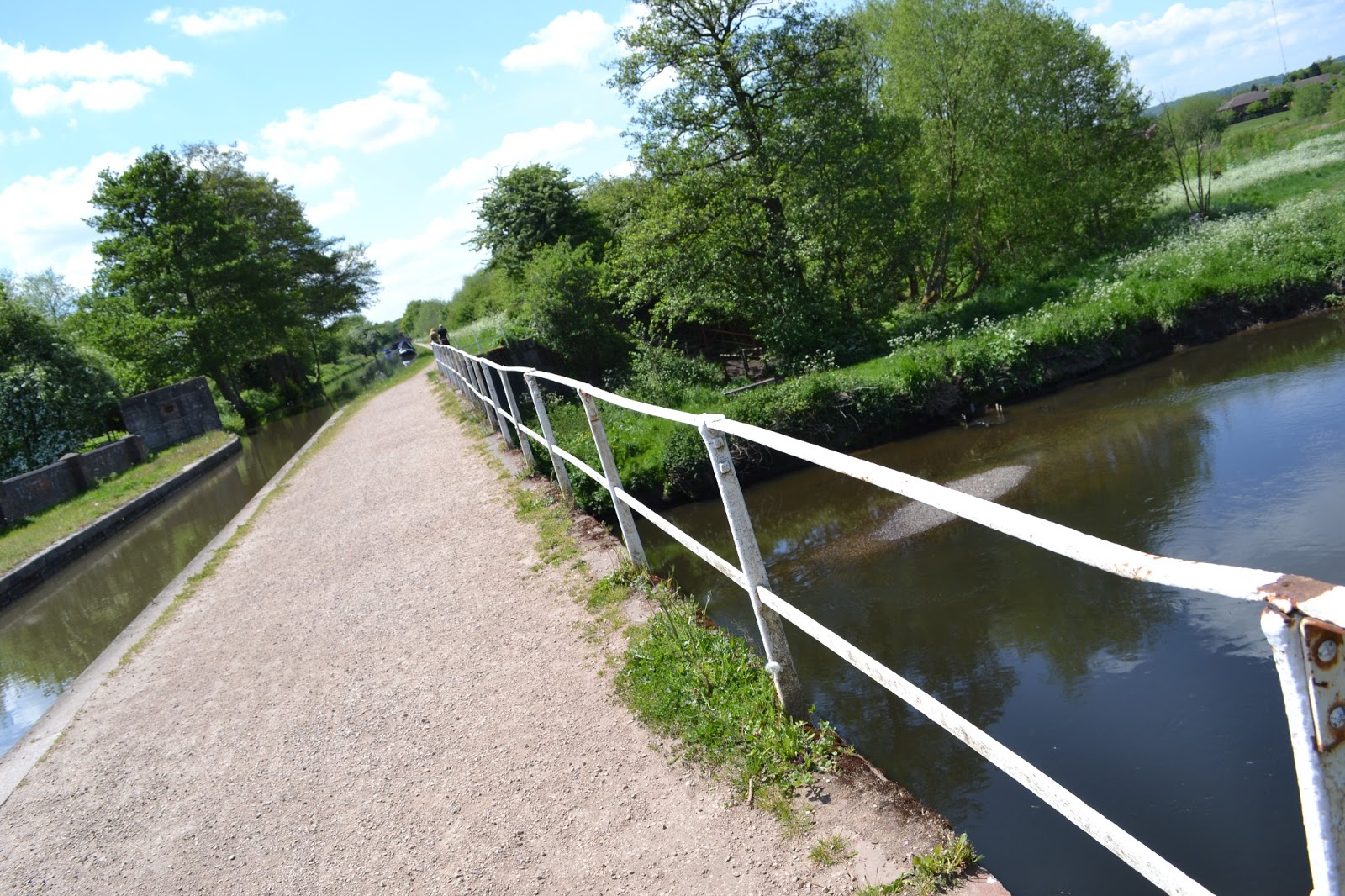
Water over water: on the left of the photo is the Coventry Canal,
while on the right-hand side is the River Tame, in the low-lying
ground below.
I've been walking on water - well over it, to be precise. Today’s Saturday Snapshot shows one of my favourite spots, where the local canal crosses a local river, and you can walk alongside water - and look down on water below you, which is a really bizarre experience.
This photo was taken earlier in the year, when things
looked very dark and bleak, but you can see the
structure of the bridge at the lower level.
I’m always amazed at the incredible engineering skills of the men who designed and built our canals, and this feature intrigues me. It’s known locally as the Fazeley Aqueduct, because it is at Fazeley, which is a very small and not terribly beautiful town in Staffordshire (there, now I’ve upset all the inhabitants, so I shall have to apologise: sorry). Anyway, the structure’s proper name is the Tame Aqueduct, and it’s quite small (there are aqueducts elsewhere in the country which are much longer and higher), and from the lower level it looks just like a brick bridge, with no sign at all of the water up above.

I found this old photo, taken sometime between 1930 and 1950,
on the Staffordshire Past Track site. It shows the old toll house
and footbridge which once stood on the aqueduct.
I think there was once a tollhouse by the side of the canal, with a footbridge from one side to the other, but there seems to be no trace of either today, although I found this old photo on the Staffordshire Past Track site, and it does seem to be the same spot.  However, there is a small concrete ‘pill box’ built during WW2 as part of a nationwide system of anti-invasion defences – you can see the openings where men (the Home Guard presumably) could shoot invading forces should the worst happen. The aim was to provide a last-ditch effort to slow the enemy by hampering and harassing them, but the buildings were usually in strategic positions on transportation routes, and I believe they were manned and used as lookout posts.
The 'pillbox' built during WW2 as part of a last-line of defences
against invasion.
Work on the canal began in 1768, so coal from Warwickshire and Staffordshire could be shipped to Coventry, and trade links could be established with other parts of the country. James Brindley, one of the greatest 18th Century canal masters, was taken on to build the waterway, but work took longer than expected, costs spiralled, and the Coventry Canal Company ran out of money, at which point it seems the directors fell out with Brindley and he was replaced. So it was not until 1785 that this aqueduct was constructed, and it was another four or five years before the 38-mile long route was finally completed.

Over the edge: Looking down at the River Tame.
A short walk along the towpath is Fazeley Junction, where the Coventry Canal meets the Birmingham and Fazeley Canal, and this spot must once have been packed with laden barges passing by in either direction. There’s are industrial units and a housing estate nearby, but you can’t see them, and up on the aqueduct it’s very peaceful, with grass and flowers growing on the towpath, and a wealth of wildlife on the water.
Wooden steps leading down to the Tameside Local Nature Reserve.
There are steps down to the area down below, where the land on either side of the River Tame has been turned into a wetland nature reserve, providing a green oasis for the busy town of Tamworth, dotted with pools, drainage channels and a man-made lake with four islands where all kinds of birds nest – with the aid of decent binoculars you can see lapwings, cormorants and terns. The riverbanks at Tameside, which were once quite steep, have been cut back to improve the habitat and create a spawning area for fish, and the last time I walked through I was lucky enough to catch glimpses of tufted ducks, but they moved too rapidly for me to catch them on camera. And there are water voles, frogs, dragonflies, damselflies and all kinds of creatures.
Another view of the aqueduct taken earlier this year.
Saturday Snapshot features photographs taken by bloggers all over the world, and is now being hosted Melinda of West Metro Mommy.

Sunday, 9 June 2013

Short Story Sunday

Back to Persephone this week, and a sweetly moving tale about enduring love, and faith. The Pain was written by South African born Pauline Smith in 1923, and is set in her native land. Juriaan van Royien and his wife Deltje have been married almost 50 years. They have no children and few possessions, and live frugally in a three-roomed, mud-walled house, scraping a living from the poor soil. But they consider themselves rich, because they have each other – and they are all in all to each other.

When Deltje falls ill and is racked with pain in her side, Juriaan cannot bear to see her suffer, so when he hears of a new hospital where the poor and sick are restored to good health he yokes his oxen to his cart, lays his wife on a nest of the feather bed, pillows and blankets, and sets off. The journey takes them three nights and the better part of three days, but when they arrive the old couple are unprepared for the fact that they must be separated. Apart, they are lonely and afraid. They miss each other and the peace and beauty of their isolated home, and they are bewildered by the interfering nurse, and the routine of hospital life.

So late one night Juriaan, who has been camping on the veld next to the hospital, hitches up his oxen again, breaks into the building, and takes his dying wife back home.

Like Susan Glaspell’s ‘From A to Z’ (the first story in the anthology), this is a simple tale, and it’s simply told, but there’s a very different feel to it, because ‘The Pain’ is about a couple whose love is so strong it has lasted for almost half a century, and everything that has happened over the years – their childlessness, their poverty, their hard life – has only served to deepen the bond between them. Juriaane and Deltje have absolute faith in each other, and in God, and those are the tenets on which their lives are built. They want for nothing: as long as they have each other they are happy, content, and joyful. There is a degree of sentimentality, which may not appeal to all modern readers, but it never seems false, and is never mawkish. I found it a very touching, very tender portrayal of a marriage, and of old age.

Smith’s short story raises questions about where and how we care for the elderly and terminally ill that are still topical and relevant. Are people better off in their own home with those they love? And do we always treat them with the respect and dignity they deserve?  Sadly, you do come across health workers like Nurse Robert, who Jurianne and Deltje fear ‘as they had never before feared any other human being’ because while she is kind, and believes she is acting for their good, she takes control, and doesn’t listen to them, or consider the way they feel, or explain anything – when the doctor makes his rounds she doesn’t allow Deltje to speak, and answers questions for her.

There’s a tremendous sense of place and space in this story, and the descriptions of the old couple’s home are so detailed I felt I could reach out and touch the mud walls, which are smeared with a protective layer of cow-dung and ashes, or the earth floor with its peach stones beaten into the surface.

I had a lump in my throat as I read of their few ‘treasures’, stored on three small shelves in the bedroom, and the account of his preparation for the journey give an indication of just how hard their life was, and how old-fashioned they must have seemed to folk in the new-fangled hospital.
He went back to the house, and stretching an old sailcloth across a bamboo frame fixed this tent to the ox cart. Under the cart he tied the big black kettle and the three-legged pot which were their only cooking utensils. He filled a small water-cask from the stream and tied that also below the cart. He brought out the painted wagon-box and fixed it in front of the cart for a seat. In the cart was their small store of provisions: biltong, a small bag of coffee, a kid-skin full of dried rusks, meal for griddle cakes, and the salted ribs of a goat recently killed. Behind the cart he tied some bundles of forage, and below the forage dangled a folding stool. On the floor of the cart he spread the feather bed, pillows and blankets for Deltje’s nest.

It’s that last sentence which is so revealing, because it tells you so much about the relationship between husband and wife – and that, above all else, is at the heart of this tale. Smith paints a touching picture of Jurianne helping Deltje into the cart and calling her ‘by those tender, beautiful and endearing names which were the natural expression of his love’.

The scene where he creeps into the room where she lies in a narrow bed and tells her he is taking her home is a masterpiece of simple elegance and understated emotion.

He stooped down, opened the locker, and drew out her clothes. With a strange, gentle deliberation he helped her into her petticoats, and tied up her Bible, her mug, and her shell-covered box. The bottle of medicine left standing on the locker he slipped into his pocket. Then he gathered the little old woman up into his arms and carried her out into the moonlit night.

And Deltje is ‘filled with that sense of security which his mere presence brought her’ and her heart is ‘overflowing with its quiet content’.


Pauline Smith is writer I’ve not heard of before, and her output does not seem to be great, but I’m curious to read more of her work. Apparently, after leaving South Africa she lived in Dorset with her mother and sister, and was close friends with the novelist Arnold Bennett, who encouraged her to write. According to the ‘Author Biographies’ at the back of The Persephone Book of Short Stories, her short story collection ‘The Little Karoo’ appeared in 1925, and ‘The Beadle’, her only novel, was published a year later.

Sunday, 2 June 2013

Short Story Sunday: Infinite Riches

My 1993 edition of Infinite Riches,
is edited by Lynn Knight.
A slight change from ‘The Persephone Book of Short Stories’ this week, because I found a copy of Infinite Riches, a Virago Modern Classics short story collection, and once I looked at it and saw the first offering was by Sylvia Townsend Warner how could I possibly resist? And I’m so glad I bought the book, because An Act of Reparation is a little gem. It opens with a shopping list – are there any other stories, short or long, which do that I wonder?

Lapsang sooshang – must smell like tar.
Liver salts in blue bottle.
Strumpshaw’s bill – why 6d?
Crumpets.
Waistcoat buttons.
Something for weekend – not a chicken.

I realise that not everyone likes lists, but I do: lists for shopping, lists of things to be done, lists of books I want to read, lists of things I must ask my mother.... I may not stick to them (in fact I rarely do) but they lend a sense of purpose to my daily routine, and make me feel a warm sense of satisfaction when I manage to tick anything off.  Occasionally I stumble across an old list, tucked inside a book, marking a long-forgotten day in my life, and I marvel at the eclectic nature of the things scrawled on scrap paper.

This list, which is a wonderful mish-mash of disparate items, belongs to Valerie Hardcastle, who has been married for five months (and cooked a chicken every weekend) when she bumps into her husband’s first wife while waiting in the bank. You might think the stage is set for a scene of bitter recriminations. Even Valerie, who knows as little about human nature as she does about housework and cooking, is a trifle concerned. But she might be surprised at her predecessor’s thoughts.

...she, Lois Hardcastle, writhing in the boredom of being married to Fenton, had snatched at snatched at Miss Valerie Fry, who had done her no harm whatever, and got away at her expense. And this, this careworn, deflated little chit staring blankly at a shopping list, was what Fenton had made her in six months’ matrimony.

The two women go to a cafe, where Lois reflects on the nature of guilt and compassion as she surveys Valerie’s shopping bags.

They were her bags, her burden: and she had cast them onto the shoulders of this hapless child and gone flourishing off, a free woman. It might be said, too, though she made less of it, that she had cast the child on Fenton’s ageing shoulders and hung twenty-one consecutive frozen chickens round his neck ... a clammy garland. Apparently it was impossible to commit the simplest act of selfishness, of self-defence even, without paining and inconveniencing others.

She whisks the younger woman off to buy the ingredients for an oxtail stew and returns to her former home to cook the dish, and there’s a hilarious passage where she hunts for her old cooking utensils, including the large stewpan, which is hidden in the cupboard under the stairs and now holds jam pots and spiders!


The story is very humorous, with a slightly witchy feel – I could imagine Lolly Willowes applauding the first wife’s actions, especially as Lois, like Lolly, seems to have finally made her own decisions about the life she wants to lead. But there’s an unsettling edge. Valerie seems spellbound by Lois, who gathers her ingredients and prepares her stew as if it were a magical potion, and whose motives may not be as unselfish as they appear. At one point Warner tells us:

No act of reparation, thought Lois, sitting in the taxi, can be an exact fit. Circumstances are like seaweed: a moment’s exposure to the air, an hour’s relegation to the past tense, stiffens, warps, shrivels the one and the other.

I think there’s an undertone of menace there that hints at decay and rottenness. And when Lois embarks on her cooking she certainly doesn’t seem to feel compassion: indeed, at this point I started thinking of Valerie and Fenton as her victims, although there is nothing explicit, and you must decide for yourself whether this an act of reparation, or a subtle form of revenge – or perhaps, in some strange way, they could even be two sides of he same coin.

Without a flutter of pity, of compunction, of remorse, of any of the feelings that should accompany an act of reparation as parsley and lemon accompany fried plaice or redcurrant jelly jugged hare, Lois searched, and cleaned, and sharpened, and by quarter to three the oxtail was in the large stewpan, together with the garlic, carrots, bay leaves, peppercorns and celery.

I love Warner’s writing, especially the way she juxtaposes small, domestic details alongside bigger issues, using unexpected turns of phrase and comparisons which give a sudden, perceptive insights into a character’s thoughts and feelings. I have no idea if this particular short story is available in any currently published collection, but if it isn’t it should be. If you haven’t come across it I would urge you to track down this book immediately, forthwith, and even sooner than that, because whatever the price it’s worth it for this story alone.