Saturday, 19 November 2011

A Classics Challenge

My mother always tells me I should finish one thing before starting another, and if I followed her advice I would post my three remaining reviews in the Ireland Reading Challenge being run by CarrieK at http://booksandmovies.colvilleblogger.com before committing to another reading challenge – but where’s the fun in that? I’m signing up for a new venture, even though I’ve still got two completed books to write up, and one to finish and review before the end of the month.  Anyway, the upcoming project, which involves reading seven classics (of which three can be re-reads) in 12 months, doesn’t start until January, so there’s no problem – other than that of deciding exactly what constitutes a classic, which demands more time and space than I have available today.

In case you’re wondering, the ‘classics challenge’ is being organised by Katherine Cox at http://novembersautumn.blogspot.com/2011/11/classics-challenge.html and she aims to make it interactive, a little like a blog hop. Although participants can still write reviews on their chosen books, the idea is that Katherine will post a ‘prompt’ on the fourth day of each month. This will, she says, be general enough for everyone to answer, no matter what they are reading, or how much they have read. There will be a form for people to link to their own post and, hopefully, to see what everyone else has written.

And what will I be reading? Well, my favoured reading matter inclines towards English speaking 18th and 19th century novelists, with a few 20th century female authors, so I have tried – not entirely successfully – to move away from this.

Charles Dickens
First up is Barnaby Rudge, one of the few Charles Dickens’ novels I haven’t read, but I have a copy given to me by my mother (who seems to feature a lot in this post), which I have been saving for next year, to celebrate the bicentenary of his birth. 

Next, Castle Rackrent, by Maria Edgeworth who was, apparently, Jane Austen’s favourite author, but somehow I’ve missed reading any of her work, so I’m looking forward to catching up.  

Now for one of my own favourites: I read my original paperback copy of Middlemarch so many times it fell to pieces, and I had to buy another edition. I was going to re-read this for the Dove Grey Reader’s 2012 team read, so I’ve included it here as well, if that’s OK.  And I’m planning a kind of pilgrimage of local places with connections to George Eliot – she was brought up in and around Nuneaton and North Warwickshire, just a few miles from where I live, and I’ve always meant to explore ‘Eliot sites’ and visit ‘her’ exhibition in Nuneaton Museum and Art Gallery.

Number Four is Pilgrim’s Progress by John Bunyan, which has been sitting on a book shelf for years and years and years. Like the Bible, it’s one of those iconic books I feel I know, because it has become part of our national culture. However, I’ve never read it, although I have dipped into it on odd occasions (usually when checking a reference found elsewhere).

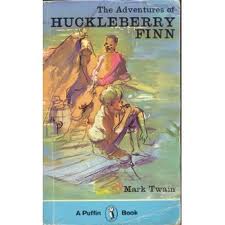
I wanted to include one children’s classic, and this was a really difficult choice, but in the end I plumped for Huckleberry Finn, mainly because I’ve recently re-read Gone with the Wind, and Twain, whose writing I always enjoy, offers another view of slavery in the American South.
Since I was trying to broaden my horizons, and English speaking authors dominated my original ‘long list’, I decided to include Columbian novelist Gabriel García Márquez. A copy of Love in the Time of Cholera has been languishing unread on a shelf for several years, and I feel it is high time this situation was remedied.

Finally I selected Graham Green’s Brighton Rock. He’s a writer who seems to have passed me by, with the exception of Travels with my Aunt which, I gather, is unlike his other novels, so I don’t quite know what to expect here.

So there we are. Seven novels in 12 months. Easy. Just as long as I don’t get side-tracked by other books...

Tuesday, 8 November 2011

Rupert Bear: A 91-year-old small boy


If you go down to the wood today – Nutwood that is – you’re in for a big surprise, because Rupert Bear is 91 today. I must admit he was never really a favourite of mine. Winnie the Pooh, yes; Teddy Robinson, yes; Paddington Bear, yes. But Rupert? No, not really. My brother and I had the odd Rupert annual at Christmas, but I didn’t hang on to them the way I did other books, or hoard pocket money to buy them myself, or beg other people to buy them for me. And, most tellingly of all perhaps, he has no voice inside my head, which may sound silly, but the characters in the books I read and loved as a child all have a voice of their own. Even now, whether they are hero or villain, I would know them if I heard them.

Anyway, whether or not I like the little white bear and his chums is immaterial, because he is still popular with thousands of children (and adults) and that’s quite an achievement. Rupert made his first appearance in a strip cartoon in the Daily Express on this day in 1920. Artist Mary Tourtel created the pictures and her husband Herbert provided the words which, unusually for a cartoon, appeared beneath the pictures, rather than in conventional ‘bubbles’. Not only that, but they appeared in verse and prose, so you could simply look at the pictures, or read the rhyming couplets (I suppose it qualifies as poetry) or read the main story line.

Former Punch illustrator Alfred Bestall took over in 1935, the year the first annual went on sale, and other artists followed him, making few concessions to changing times or fashions – Rupert still wears his trademark yellow checked trousers, matching scarf and red jumper. He goes off and has adventures, and returns to his cosy home and his loving mum and dad, just as he did all those years ago when I was a child. He lives in a fairytale world where elves, wizards and dragons exist alongside pirates and smugglers, but for me it always lacked the allure of Andersen and the Brothers Grimm, or the magical created worlds of Narnia or the Shire.

As far as I can see Rupert and his ‘chums’, who include Bill Badger, Edward Trunk, Pong-Ping the Pekingnese and Algy Pug are essentially small boys with animal heads. Mostly they seem to have human hands and feet, and they lead human lives, in human houses. I’m not sure why this bothers me, but it does. Somehow Ratty, Mole, Pooh, Paddington and a host of other literary creatures are credible as animals in a way that Rupert is not. And, I might add that the Rupert illustrations lack the charm of EH Shepard or Peggy Fortnum, but that’s a personal opinion and I’m sure others will disagree.

He still appears in the Daily Express, an annual is published each year, and there are spin-off TV shows and DVDs, as well as toys and games, while Canterbury, home of Rupert creator Mary Tourtel, has a series of plaques marking key locations, as well as a Rupert Bear Museum.  The Followers of Rupert Bear have a fascinating website which is well worth a look, whether or not you are a fan – you’ll find it at http://www.ee.ed.ac.uk/~afm/followers/

Monday, 7 November 2011

The Brendan Voyage

It's time for Book Number Three in the Ireland Reading Challenge at organised by CarrieK at http://booksandmovies.colvilleblogger.com, and it’s a re-read of Tim Severin’s The Brendan Voyage. Severin and his companions sailed a leather boat across the Atlantic, in a bid to prove that St Brendan could have journeyed to America in the 6th century, and to show that the fantastical places visited by the Irish monk en route to the Isles of the Blessed really did exist.

The story of how Severin built and equipped his boat makes fascinating reading, his account of life at sea in the cramped quarters of  a small open boat is riveting, and he also gives details of the saint's voyage.  I wrote a review on this book on St Brendan's Day (May 16),  and Carrie said I can include it in the Challenge, so I've created  link for you -just click on http://goo.gl/nKoKB.

And, as an added extra, here's another link, to Irish singer and songwriter Christy Moore singing St Brendan’s Voyage on his album  Ordinary Man, at  http://youtu.be/Y26Oh2KX9II. If you've never heard Christy Moore you've missed out, so take a listen, please.

Thursday, 3 November 2011

November: The Month of the Drowned Dog

No review today. Instead I’m posting a poem: a Ted Hughes’ poem, to mark the fact that his funeral took place today in 1998. And the poem is... November. This was one of the first Hughes poems’ I read, in a school ‘O’ Level anthology (Poets of Our Time, edited by FES Finn) and I can still remember how new and exciting his work seemed, and the shock of the opening sentence of this poem.

By coincidence it has just been announced that a memorial to Hughes will be placed in Poets’ Corner at Westminster Abbey on December 6, at a special dedication service, with a reading by Hughes’ friend and fellow poet Seamus Heaney. There is already a memorial stone on Dartmoor.

I’m not going to attempt to analyse the poem, as I think it speaks for itself, but I’ve always thought it seems much closer to the reality of a cold, wet autumn than Keats’ season of mists and mellow fruitfulness. 

November

The month of the drowned dog. After long rain the land
Was sodden as the bed of an ancient lake.
Treed with iron and was bird less. In the sunk lane
The ditch – a seep silent all summer –

Made brown foam with a big voice: that, and my boots
On the lanes scrubbed stones, in the gulleyed leaves
Against the hill’s hanging silence;
Mist silvering the droplets on the bare thorns

Slower than the change of daylight.
In a let of the ditch a tramp was bundled asleep.
Face tucked down into beard, drawn in
Under his hair like a hedgehog’s. I took him for dead,

But his stillness separated from the death
From the rotting grass and the ground. The wind chilled,
And a fresh comfort tightened through him,
Each hand stuffed deeper into the other sleeve.

His ankles, bound with sacking and hairy hand,
Rubbed each other, resettling. The wind hardened;
A puff shook a glittering from the thorns,
And again the rains’ dragging grey columns

Smudged the farms. In a moment
The fields were jumping and smoking; the thorns
Quivered, riddled with the glassy verticals.
I stayed on under the welding cold

Watching the tramp’s face glisten and the drops on his coat
Slash and darken. I thought what strong trust
Slept in him- as the trickling furrows slept,
And the thorn roots in their grip on darkness;

And the buried stones taking the weight of winter;
The hill where the hare crouched with clenched teeth.
Rain plastered the land till it was shining
Like hammered lead, and I ran, and in the rushing wood

Shuttered by a black oak leaned.
The keeper’s gibbet had owls and hawks
By the neck, weasels, a gang of cats, crows:
Some stiff, weightless, twirled like dry bark bits

In the drilling rain. Some still had their shape,
Had their pride with it; hung, chins on chests,
Patient to outwait these worst days that beat
Their crowns bare and dripped from their feet.

A memorial stone to Ted Hughes
on Dartmoor

Wednesday, 2 November 2011

A Sentimental Journey

Right, here as promised, is my second book in the Ireland Reading Challenge organised by CarrieK  at http://booksandmovies.colvilleblogger.com. In my last post I said I was a little out of synch due to my holiday on the Isle of Man, but although I didn’t do much writing, it was a good place to read, and I managed to complete one of my ‘new’ choices – A Sentimental Journey, by Laurence Sterne.

Sterne, born in Clonmel in Ireland in 1713, is best known for the incomparable The Life and Opinions of Tristram Shandy, Gentleman, which is quite unlike any other book in the English language, butI knew nothing of him or his other work until I spotted this in a charity shop.

Now back home and re-connected to the internet, I’ve done a bit of research and discovered that Sterne spent his childhood moving around Ireland with his father’s regiment, but at the age of 10 was sent to relatives in Yorkshire. In 1738 he became a vicar in a village near York, where he lived for some 20 years, during which time his writing was confined largely to letters and sermons, with a little politics thrown in. He was 46 when he penned the first volume of Tristram Shandy in 1759, and his writing career was brief as he died from consumption less than a decade later.
A Sentimental Journey, envisaged as a four-volume venture, charting a trip through France and Italy, was published in only two sections in 1768, just a few weeks before Sterne’s death. It was completely different to any previous travel book, satirising the pompous descriptions of Grand Tours where authors focused on descriptions of scenery and buildings, with plenty of classical allusions and observations on local customs, religion, antiquities and so on.

Instead Sterne’s work, which purports to be written by Mr Yorick, highlights his encounters with , such as La Fleur, the cheerful but inexperienced manservant he employs in France; an elderly monk seeking donations for his convent; a down-on-his-luck Chevalier who has turned his hand to patisserie, and Monsieur Le Count de B**** who sorts out his passport problem (‘Yorick’ has travelled to France, now at war with England, without the necessary document, and fears he may end up in the Bastille).

Then there are the women he meets – Yorick (like Sterne himself) has an eye for  the ladies and obviously enjoys their company, whether they be working girls or society women – at the end of the book  he finds himself sharing an inn room with a fine lady and her maid.

Alongside that he finds time to mention the small,  idiosyncratic things that catch his eye: a dead donkey blocking their road, or a caged starling endlessly repeating the words ‘I can’t get out’  (which he sees as a reflection on his own situation should he fail to solve his passport problem).

Describing the various types of traveller he tells us he has decided to be ‘sentimental traveller’ and that his observations will be ‘altogether of a different sort’ to anyone else. He says: 
   “I have not seen the Palais royal; - nor the Luxembourg – nor the Façade of the Louvre – nor have attempted to swell the catalogues we have of pictures, statues and chuches – I conceive every fair being as a temple, and would rather enter in and see the original drawings and loose sketches hung up in it, than the transfiguration of Raphael itself."
That is a pretty accurate description of the book, which has no plot and is probably closer to the picaresque tradition than anything else, consisting of a series of loosely connected episodes. It’s difficult to know whether the book represents a true account of Sterne’s travels (he journeyed abroad in 1762-4 and again in 1765-6), whether some aspects were borrowed by the experiences of acquaintances – or whether incidents and people are totally fictitious.

It’s a very slender volume, but I found it required concentration. Stylistically it isn’t always an easy read, and language has changed over the last two and half centuries. Some words have altered their meaning, while others have fallen out of use. To some extent I suppose, A Sentimental Journey has become something of a curiosity, but it has a certain charm, not least because Sterne accepts that people are a mix of good and bad, just as he accepts the conflict between the demands of the flesh and the spirit, in himself and others.


Strangely, after his death his body was stolen by grave robbers for anatomy students, but was recognized and reburied in unmarked grave at Paddington. A skull believed to be that of Sterne (the top was sawn off, a custom carried out by medical students) was recovered in 1969, and reburied in the graveyard of St Michael's Church, Coxwold.