Sunday, 11 December 2011

The Country Child's Christmas

I’m celebrating Day 11 of the Advent Bookfest with a 1952 Faber and Faber edition of Alison Uttley’s The Country Child, illustrated with woodblock engravings by CF Tunnicliffe. Uttley is probably best known for her children’s books, especially the Little Grey Rabbit stories with their beautiful pictures painted by Margaret Tempest, so I’ve included one, because I can't resist it - here's Little Grey Rabbit and Hare, by the fire, which is decorated for Christmas.

The country customs described in these books were still in practice in the author’s childhood, which she recalled in a fictionalised account in The Country Child. Like Uttley herself, Susan Garland lives in an isolated Derbyshire farm - every day she walks four miles to school and four miles back, living a life that must have seemed quaint and old fashioned to many of the girls she knew, and the book is a treasure trove of information about a way of life long gone, seen through the eyes of a lonely, imaginative girl.

Uttley’s description of the preparations for Christmas, and the celebrations on the big day itself are enchanting. The house is full of food, enough to see the family and farm workers through the whole winter. Bacon and hams hang from the kitchen ceiling; apples and onions have been stored, and there are pickles and spices, jams, plum puddings, wine, mince pies and Christmas cheeses with sage running through the middle ‘like green ribbon’ – all home-made, of course.

The house has been cleaned until everything gleams and is festooned with holly, boughs of fir and ivy berries, dipped in the red raddle left over from sheep marking.  
“In the middle of the kitchen ceiling there hung the kissing bunch, the best and brightest of holly, made in the shape of a large ball which dangled from the hook. Silver and gilt drops, crimson bells, blue glass trumpets, bright oranges and red polished apples, peeped and glittered through the glossy leaves. Little flags of all nations, but chiefly Turkish for some unknown reason, stuck out like quills on a hedgehog. The lamp hung near, and every little berry, every leaf, every pretty ball and apple had a tiny yellow flame reflected in its heart.“Twisted candles hung down, yellow, red, and blue, unlighted but gay, and on either side was a string of paper lanterns.”
If you enjoy Flora Thompson’s Lark Rise to Candleford, another fictionalised account of a country childhood at the end of the 19th century, then I am sure you will love The Country Child, with its detailed observations of nature and weather, the descriptions of people who worked and visited the farm, and the events that Uttley remembered – Christmas, Easter, Harvest, her first day at school and a visit to the circus.

Uttley, born Alice Taylor in 1884, studied physics at Manchester University and became a teacher. She only started writing to support herself and her son following the suicide of her husband, who suffered mental illness after serving in WWI. She died in 1976. To find out more about her, look at the Alison Uttley Society website http://www.alisonuttley.co.uk/main.html.

Saturday, 10 December 2011

The Green Knight

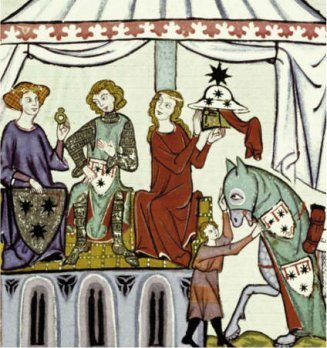
This illustration, taken from a Medieval manuscript, is on
the front cover of  an old Penguin edition of Sir Gawayne and the Green Knight.

Day Ten, and I’ve travelled back in time to 14th century, and the tale of Sir Gawayne and the Green Knight, written by an unknown poet around 1360. King Arthur and his court are holding their Christmas feast at Camelot when a strange knight – a green giant – appears and challenges one of the knights to decapitate him – but in return the knight must visit him for the blow to be returned. Sir Gawayne accepts the challenge, and much of the poem describes his adventures, but it opens with the great Christmas Feast, and the shock arrival of the Green Knight.
This always me wish I’d studied Middle English. Actually, it’s not that difficult to get the gist of what is being said, but I am sure I would appreciate it far better if my knowledge were greater. As it is, I have to make do with modern translations. Ideally I would like the Simon Armitage version, but somewhere I have an old Penguin edition, as well as the Tolkien. However,, despite my recent reorganisation of the bookshelves, I could not find either, so I’ve had to resort to Project Gutenberg (again) where there are several versions.

Anyway, here is the bit where the Green Knight arrives at court:

“So, as I said, the great doors opened wide.
In rushed a blast of winter from outside, 
And with it, galloping on the empty air, 
A great green giant on a great green mare Plunged like a tempest-cleaving thunderbolt, And struck four-footed, with an earthquake's jolt,
Plump on the hearthstone.
There the uncouth wight 
Sat greenly laughing at the strange affright That paled all cheeks and opened wide all eyes; Till after the first shock of quick surprise 
The people circled round him, still in awe, And circling stared; and this is what they saw: 
Cassock and hood and hose, of plushy sheen Like close-cut grass upon a bowling-green, Covered his stature, from his verdant toes To the green brows that topped his emerald nose. 
His beard was glossy, like unripened corn; His eyes shot sparklets like the polar morn. 
But like in hue unto that deep-sea green Wherewith must shine those gems of ray serene 
The dark, unfathomed caves of ocean bear. 
Green was his raiment, green his monstrous mare. 
He rode unarmed, uncorsleted, unshielded, 
Except that in his huge right hand he wielded A frightful battle-axe, with blade as green
As coppery rust;—but the long edge shone keen.”


Friday, 9 December 2011

All the Christmases are One

One of  Edward Ardizzone's illustrations
for  A Child's Christmas in Wales.

Day Nine of the advent Bookfest, and it’s Dylan Thomas, with A Child’s Christmas in Wales, an amalgam of all the Christmases you’ve ever known, a magical mix of myth and reality. As he says: 
“One Christmas was so much like another, in those years around the sea-town corner now and out of all sound except the distant speaking of the voices I sometimes hear a moment before sleep, that I can never remember whether it snowed for six days and six nights when I was twelve or whether it snowed for twelve days and twelve nights when I was six.” 
Who hasn’t felt like that when trying to capture the memory of a Christmas past? And what about this paragraph, which couldn’t possibly be written by anyone other than Thomas:
“All the Christmases roll down toward the two-tongued sea, like a cold and headlong moon bundling down the sky that was our street; and they stop at the rim of the ice-edged fish-freezing waves, and I plunge my hands in the snow and bring out whatever I can find. In goes my hand into that wool-white bell-tongued ball of holidays resting at the rim of the carol-singing sea, and out come Mrs. Prothero and the firemen.” 
Dylan Thomas
There’s so much to choose from here: the snow, the presents (useful and useless), the postmen the relatives, the food, the music, the games, the cats, a fire...

But I’ll plump for his description of Christmas dinner and the afternoon, with its blend of the ordinary and the extraordinary, and the sense of anti-climax that follows when gifts have been opened and the meal eaten. 
“For dinner we had turkey and blazing pudding, and after dinner the Uncles sat in front of the fire, loosened all buttons, put their large moist hands over their watch chains, groaned a little and slept. Mothers, aunts and sisters scuttled to and fro, bearing tureens. Auntie Bessie, who had already been frightened, twice, by a clock-work mouse, whimpered at the sideboard and had some elderberry wine. The dog was sick. Auntie Dosie had to have three aspirins, but Auntie Hannah, who liked port, stood in the middle of the snowbound back yard, singing like a big-bosomed thrush. I would blow up balloons to see how big they would blow up to; and, when they burst, which they all did, the Uncles jumped and rumbled. In the rich and heavy afternoon, the Uncles breathing like dolphins and the snow descending, I would sit among festoons and Chinese lanterns and nibble dates and try to make a model man-o'-war, following the Instructions for Little Engineers, and produce what might be mistaken for a sea-going tramcar.” 
It’s hard to know if this is poem, prose, memoir or short story, but the label doesn’t matter because it is such a wonderful piece of writing. If you’ve never read it, please do – you’ll find it online at http://www.poemhunter.com/poem/a-child-s-christmas-in-wales/.

Thursday, 8 December 2011

Mayhem,Murder and Dionysian Frenzies

I know, I promised an Advent Bookfest, and here is a book about mayhem and murder, but I was having an end of year tidy-up in the electronic filing room, when I found a folder full of unpublished and unfinished posts. I’ll start with Donna Tart.  How come I haven’t encountered her work before?  Where have I been that I missed her? I LOVED the way she writes - subject-wise it's not necessarily my usual taste, but I couldn't put this book down. Two nights running I sat in bed reading into the early hours.

The Secret History was erudite, scholarly, steeped in knowledge of the classics and ancient Greek.  By the end I had a list of facts to be checked out and books to be discovered or revisited.  Homer and Marlow have been unearthed and added to the reading pile (at this rate it will soon be as tall as me) while the wish list bears the cryptic notes ‘Jacobean and Greek tragedy’, ‘more Tartts’ and ‘decent atlas’. This is why I read in such a random fashion:  I start one book, and it sends me off in all sorts of other directions (just like The Queen in Alan Bennett’s The Uncommon Reader). Usually I have several books on the go at once, so the ‘must haves’, ‘re-reads’ and ‘find-out-mores’ frequently threaten to overwhelm the house, and I find myself shifting stacks of books from place to place, in a mad variation of musical chairs.
         
Anyway, enough of that – let’s get back to The Secret History. Initially I found it difficult to buy into the Dionysian frenzy, but the story drew me in, step by step, unfolding a tale of horror, but showing how easy murder can be.  Once set on their destructive path Tartt’s elite group of students cannot withdraw, but it is the small irritations presented by their victim that prove the final straw. They are curiously amoral about committing not one, but two murders (the second is a consequence of the first), but the effects of their actions are far reaching, and all are visited by a kind of Nemesis which prevents them reaching their potential.

The climax of the novel is shockingly unexpected, but is the only possible outcome. After that the tale flattens out as the last few pages relate the broken dreams and wasted lives of those who are left. 

On the face of it the narrator, Richard, is the outsider, unable to accept his own dull upbringing, desperate to be accepted by his wealthy, glamorous, clever colleagues, and determined to pursue literary beauty ‘at all costs’. But his new found friends are equally anxious to be part of a surrogate family.  None are exactly what they seem, and all have been scarred by their childhoods: Bunny, whose banking family leave him perpetually short of cash; Francis, wealthy, gay and promiscuous, at war with his socialite mother and her toy-boy second husband; twins Charles and Camilla, oddly close, brought up by relatives after the death of their parents, and Henry, suave, calm and impossibly intelligent. Central to the action, he remains something of an enigma: I found it difficult to tell if he is saint or sinner, manipulator or victim.  Is he what he seems or, like the others, has he created a persona that helps him face the world?

There are echoes of Waugh’s classic Brideshead Revisited, which also revolves around an outsider seduced by the surface glamour of an elite group where the central character has a fatal flaw, and lives fall apart as the real world intrudes on their enchanted circle. Similar territory is explored in Naomi Alderman’s The Lessons and The Line of Beauty by Alan Hollinghurst, neither of which I enjoyed.

Wednesday, 7 December 2011

King John's Christmas


Two for the price of one today. Since I am in poetic mood, here is AA Milne's King John's Christmas, copied from When We Were Very Young, which is the first book I was ever given, when I was less than a year old.
King John was not a good man –
He had his little ways.
And sometimes no one spoke to him
For days and days and days.
And men who came across him,
When walking in the town,
Gave him a supercilious stare,
Or passed with noses in the air –
And bad King John stood dumbly there,
Blushing beneath his crown.


King John was not a good man,
And no good friends had he.

He stayed in every afternoon…
But no one came to tea.
And, round about December,
The cards upon his shelf
Which wished him lots of Christmas cheer,
And fortune in the coming year,
Were never from his near and dear,
But only from himself.

King John was not a good man,

Yet had his hopes and fears.
They’d given him no present now
For years and years and years.
But every year at Christmas,
While minstrels stood about,
Collecting tribute from the young
For all the songs they might have sung,
He stole away upstairs and hung
A hopeful stocking out.

King John was not a good man,

He lived his live aloof;
Alone he thought a message out
While climbing up the roof.
He wrote it down and propped it
Against the chimney stack:
“TO ALL AND SUNDRY – NEAR AND FAR -
F. Christmas in particular.”
And signed it not “Johannes R.”
But very humbly, “Jack.”

“I want some crackers,

And I want some candy;
I think a box of chocolates
Would come in handy;
I don’t mind oranges,
I do like nuts!
And I SHOULD like a pocket-knife
That really cuts.
And, oh! Father Christmas, if you love me at all,
Bring me a big, red, india-rubber ball!”

King John was not a good man –

He wrote this message out,
And gat him to this room again,
Descending by the spout.
And all that night he lay there,
A prey to hopes and fears.
“I think that’s him a-coming now!”
(Anxiety bedewed his brow.)
“He’ll bring one present, anyhow –
The first I had for years.”

“Forget about the crackers,

And forget the candy;
I’m sure a box of chocolates
Would never come in handy;
I don’t like oranges,
I don’t want nuts,
And I HAVE got a pocket-knife
That almost cuts.
But, oh! Father Christmas, if you love me at all,
Bring me a big, red, india-rubber ball!”
King John was not a good man,

Next morning when the sun
Rose up to tell a waiting world
That Christmas had begun,
And people seized their stockings,
And opened them with glee,
And crackers, toys and games appeared,
And lips with sticky sweets were smeared,
King John said grimly: “As I feared,
Nothing again for me!”

“I did want crackers,

And I did want candy;
I know a box of chocolates
Would come in handy;
I do love oranges,
I did want nuts!
And, oh! if Father Christmas, had loved me at all,
He would have brought a big, red,
india-rubber ball!”

King John stood by the window,

And frowned to see below
The happy bands of boys and girls
All playing in the snow.
A while he stood there watching,
And envying them all …
When through the window big and red
There hurtled by his royal head,
And bounced and fell upon the bed,
An india-rubber ball!

AND, OH, FATHER CHRISTMAS,

MY BLESSINGS ON YOU FALL
FOR BRINGING HIM
A BIG, RED,
INDIA-RUBBER
BALL!