Sunday, 11 August 2013

Ladies Who Lunch - With a Hidden Past!

Somehow, as I read this short story I thought of our two ladies being Edwardian, but
there are references to flying and a speakeasy, which would place it in the 1920s or
the early '30s. I our imagine the duo slightly older and stouter than this pair, and
wearing their furs, despite the mid-day heat, but this is the best I could come up with.
From the table at which they had been lunching two American ladies of ripe but well-cared-for middle age moved across the lofty terrace of the Roman restaurant and, leaning on its parapet, looked first on each other, and then down on the outspread glories of the Palatine and the forum, with the same expression of vague but benevolent approval.

Short Story Sunday has reached 1934 and arrived in Rome, where friends Grace Ansley and Alida Slade are on holiday. On the face of it all is well, but as they chat about their daughters and reminisce about their own youth and a long-ago vacation in the city, it slowly dawns on you that all is not quite as it seems.

Edith Wharton’s Roman Fever is one of the many gems in The Persephone Book of Short Stories. It’s short, slight and perfectly formed, as everything builds oh-so-quietly to the disclosure of secrets as well-kept as the women who have guarded them for so many years.

Wharton quietly creates a picture of wealthy widows who are, on the whole, satisfied with their lives and position in well-to-do American society, and have maintained their girlhood friendship despite their differences. But there are clues that Grace and Alida are not quite as amicable as it seems, for although they have a tendency to feel sorry for each other, each visualises the other ‘through the wrong end of her telescope’. And beneath the calm surface of their lives old passions run deep. Love, jealousy and revenge are a potent mix, as dangerous in middle age as they are in youth – more so perhaps, because the adversaries have learned to mask their emotions while they nurse their hatred.

It is, I suppose, classic Wharton territory, an age-old story of a man and a woman who meet and fall in love, but are destined to part because he has existing commitments to another woman, so a happy outcome is impossible. What comes to light here is a tale of two young girls in love with the same man, and the lengths one went to ensure she kept him. She smiles as she tells her rival about the letter she forged, hoping the other girl would attend a non-existent lovers’ tryst and fall ill from the chill night air, paving the way to her own success and marriage. And she justifies her actions because she was actually engage to the man in question.

All these years the woman had been living on that letter. How she must have have loved him, to treasure the mere memory of its ashes! The letter of the man her friend was engaged to. Wasn’t it she who was the monster?

And you think to yourself, that’s it, that’s the reason for the unease that mars the relationship between two middle-aged women who have known each other all their lives. But Wharton has a trick up her sleeve and the story is not over yet, for the victim of this cruel prank has a trump card to play... And as she discloses her own hidden secret the balance shifts, and you see things from a different perspective, and wonder who the victor in this battle for love really was, and which of them has been the happiest – and who it was who really did capture the heart of the man.

Saturday, 10 August 2013

A Kaleidoscope of Butterflies!

A Peacock butterfly perched on a white buddleia - isn't he glorious?
I’ve neglected my garden shamefully, and it’s terribly overgrown and out of hand, so I’ve been out there this week trying to hack back the jungle. And on Wednesday my efforts were reward by the most beautiful and amazing sight – butterflies! Hundreds and hundreds of them on the buddleias. It was absolutely magical. Every bloom seemed to have two or three butterflies, and the air was full of them, flapping and fluttering and flying like a flock of birds, and they seemed huge. Mostly they were large whites, which were most uncooperative about being photographed, and spectacular peacocks, which were a little more helpful, but still jolly difficult to capture on camera. According to Webster’s online dictionary and thesaurus, there is a choice of collective nouns for groups of butterflies. They suggest a flight, a rabble, a flutter, a swarm or a kaleidoscope...so I thought I’d settle settle for kaleidoscope because it sounds so nice. 
And another Peacock butterfly, showing the underside of the wings. 
I have a couple of buddleias in the garden, which I acquired under the misapprehension that they would remain a manageable size – their nickname of butterfly bush lulled me into a false sense of security but they are not bushes at all. They are not small, and they are not slow-growing, as you might expect with a shrub. They are rampant, and have aspirations for the high life, and grow into tall trees, and spread, and spread and spread... not suitable for a small garden in any way, shape or form, but I am reluctant to cut them down because they are such an attraction for wildlife. And squeezed into the narrow space between our fence and the new housing development at one side of the very end of the garden are masses and masses of these monsters,  with flowers in all shades of lilac, purple and creamy white, and they were absolutely smothered in butterflies, and the air around them was thick with the insects.
Basking in the sunshine. The outspread wings of the Peacock
butterfly have the most incredible markings.
Sadly the trees on the other side of the fence were far too tall to get any pictures. I suppose you would need a telephoto lens for a successful shot, though I did consider getting the stepladder out, but I’m terribly clumsy so it seemed to be asking for trouble!
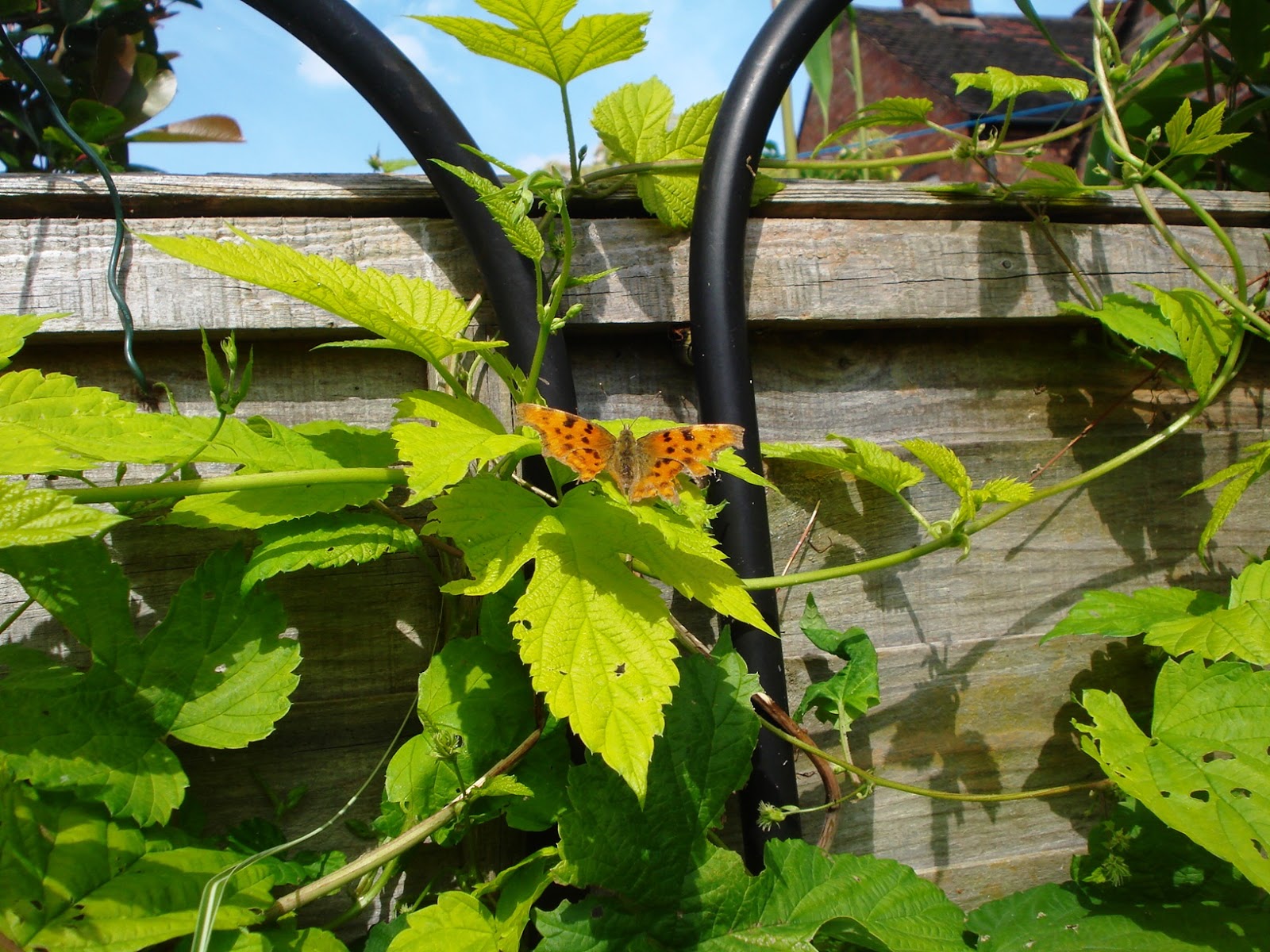
This small butterfly on the golden hop is a Comma.
Anyway, I did get a few decent shots of Peacock butterflies on the smaller buddleias in the garden, and I managed to get a picture of a small orange and brown butterfly basking on my golden hop, which I bought because a) It looks like sunshine, and b) It is really called Humulus Lupulus, which I think is such a wonderful name. Anyway, I had quite some problems identifying this butterfly, so in the end I copied the photo, and blew it up as big as I could, and then realised the lone visitor has the distinctive raggedy wings of a Comma. And, just to clinch matters, the larvae feed on Humulus Lupulus (among other things).
I've tried to crop the photo to get a bigger image, so you
can see the raggedy edges of the wings.
The glory in the garden lasted a couple of days. from early morning until dusk, when the butterflies were drowsy and bumbled through the air as if they were drunk - and perhaps they were, drunk on all that nectar they'd consumed! There were lots of bees as well, all collecting pollen, but they were a bit overshadowed by the butterflies. By yesterday (Friday) they had all disappeared, the blooms had turned brown and were obviously dying, and the weather had taken a turn for the worse, damp and cloudy, with an almost autumnal chill in the air. I suppose the insects are laying eggs ready to be transformed into more of these beautiful, delicate creatures next Spring, and the trees will produce seeds which will be scattered and fall to the ground to produce new growth... so the cycle of life continues!
Bee happy... Hopefully, this is a honey bee, but I don't know
enough about them to even guess at the species.
Saturday Snapshot is hosted by Melinda at West Metro Mummy.

Friday, 9 August 2013

Sleepless Nights and Tea Rationing

Last night was one of those when I woke up and couldn’t get back to sleep, so I went downstairs, made a cup of tea, and carried on reading Few Eggs And No Oranges, the wartime diaries of Vere Hodgson, and thought how odd that I should be sitting there, sleepless for no particular reason, while reading her account of nights broken by air raid warnings, the sound of planes overhead, and the noise of bombs exploding around her. And, since tea was rationed, I guess there wasn't always enough for a comforting cuppa in the middle of the night!

I’ve only read the entries for the first few months, but I’m loving it so far. As with all good diaries, the juxtaposition of major national and international events with the mundane and commonplace makes for fascinating – and compelling – reading. And Hodgson makes no effort to marshal her thoughts in a coherent fashion. Details of a raid are followed by accounts of a day at the office, and then by more about the bombs, while gossip about friends and family is interspersed with serious news items about Government ministers, shortages, or updates from battle fronts.

Her portrayal of politicians is fascinating. Figures that I only know from old newsreel clips and newspaper cuttings spring to life.  Chamberlain is every bit as dull, boring and uninspiring as I expected, and Churchill is every bit as charismatic. But who would have thought de Gaulle was such a sensational orator, speaking out against the ‘dishonourable’ Petain Government and rallying the French Resistance. I remember him as an old man, poker-faced, with a big nose, much lampooned by cartoonists in the British press for his unbending stance on us joining Europe, and I find it difficult to think of him ever being young, let alone being so passionate and brave about his country.

The diary starts on Tuesday, 25th June, 1940, and Hodgson leaps straight in – short, sweet, and very much to the point. “Last night, at about 1am, we had the first air raid of the war on London,” she tells us. Her room is opposite the police station, so she gets the ‘full benefit’ of the sirens.

It made me leap out of bed half way across the room. I shook all over, but managed to get into my dressing-gown and slippers, put my watch in my pocket, clutch my torch and gas-mask, and get downstairs first.

Her landlady is ‘rearing’ mattresses against the door (for protection, I suppose). Everyone shares sweets, chat and jokes, before returning to bed because all is quiet – only to be woken again when the All Clear sounds. For some time life remains quiet, despite the Warnings, but gradually things hot up, and nights – and days – are disturbed by sirens, planes, falling bombs, and the bright blaze of burning buildings. I know about the war from history books but I was thoroughly shaken by the scale of the bombing, not just on London, but elsewhere in the country as well. And the noise was indescribable. The words hellish and nightmare don’t even begin to give a flavour of what life was like during the Blitz. And all the time people were on tenterhooks waiting to hear if friends and relatives were safe, and anxious about what British Troops were doing. Many people, including Hodgson, seem to have taken a personal interest in the fate of ‘Our Boys’, but news was often slow filtering through to the Home Front. 

Yet through it all she remains cheerful and alert. She’s curious about the war and its impact on people’s lives, and is very observant, sympathetic, and yet slightly detached, which makes her an excellent recorder of events. Her voice comes across loud and clear over the years. Friends, apparently, described her as brisk, and so she is. She’s intelligent, capable, has a keen sense of right and wrong and is always willing to help others (I’m sure she would have been a good person to have around in a crisis). She’s also got a sense of humour, and is game for anything, attending lectures and courses learning how to deal with bombs, gas attacks, fires, injuries and all kinds of terrors. On one occasion she’s left bruised and battered after being dragged down a flight of stairs whilst acting as the ‘victim’ who must be rescued.

There are details about rationing, queues and food shortages (eggs and oranges were always
in short supply, hence the title of the book), and on July 8 Hodgson notes: “We listened to the news, and heard the bombshell about tea! Two ounces per head, per week!” However, she adds, it will do for her because she doesn’t like her tea strong. I was reminded of George Orwell who, unlike Hodgson, did like his tea strong, and wrote a very funny essay on the subject of ‘A nice Cup of Tea’ which appeared in the Daily Express in 1946 (tea rationing didn’t come to an end until 1952, although by then the weekly amount had risen to 3oz). According to him the 2oz ration (this was loose tea remember , no tea bags then!) made around 20 cups, which is only two or three a day – not a lot  when you think about it. No wonder housewives eked it by following the Minister of Food's advice to use ‘one spoonful for each person and none for the pot’, and eked out their meagre supply by reusing the dregs.

One of the things which surprised me was the extent to which Hodgson travels around: she meanders around London to look at bomb damage, and makes regular trips to Birmingham to see her mother and sister, as well as visiting other friends and relatives. Travel is disrupted, but trains, buses and tubes still run, even though there are often lengthy delays. Thinking about it, I am not sure why I was so surprised, because my mother has told me how the parents of evacuees billeted with her family would catch the train out from Waterloo and spend Sundays with them. And later on in the conflict Mum used to travel into town with the girls to visit their homes.


There is so much packed into these diary entries that it’s taking me a while to read, and I keep getting side-tracked and going off to look things up, to hunt out other books from the period (has anyone got any recommendations?) and to ring my mother for more of her wartime memories. I’m only at the end of 1940, and these first six months have taken me on so many detours – Anderson Shelters, rationing in general, tea rationing (which led to a further exploration on the history of tea), General de Gaulle and the French Resistance, the Ministry of Food, wartime recipes, the Fall of France, the Occupation of Jersey...  I would love a street map of wartime London, to locate the places mentioned. As you can see, the list of Things I Need to Know is likely to get even longer, and at this rate it may be quite some time before I finish reading!

Saturday, 3 August 2013

A Misty Moisty Morning...


Burrator Dam, at one end of Burrator Reservoir on Dartmoor.
The road runs across it, so you can walk across and look down
at the water , which is an awfully long down down!
This week we have been to visit my Elder Daughter and her Boyfriend in Plymouth, and had a wonderfully relaxing time being made a fuss of and looked after as if we were really special people. They cooked us wonderful meals, beautifully served up, with the table all laid out properly, and we’ve had home-grown salad, and courgettes, and home-made icecream )not together, I hasten to add, different courses!). And there was home-made wine, poured from a glass decanter – there’s posh for you! I kept offering to help, but I wasn’t allowed to do anything. No washing up, no cooking, no tidying, no cleaning, no washing, no ironing... Sheer bliss! All I did was chill out and enjoy myself, and being so pampered made me feel like Royalty! The Man of the House was just as happy, especially as Elder Daughter and her Boyfriend took out us out and about, so he didn’t have to worry about driving or parking. 
Lakeside view: Burrator Reservoir shrouded in mist.
One of our trips was up on to Dartmoor, where we walked around the Burrator Reservoir, which is where Plymouth's drinking water comes from. Back at the house it seemed odd to think that we’d seen the source of all the water that came out of the taps for drinking and washing and so on, and I got the laptop out to do a bit of research for a Saturday Snapshot.
The trees looked spooky as the mist turned them to
silhouettes in shades of black, grey and very dark green.
Anyway, it was a misty, moisty sort of morning, which made for a very atmospheric walk as trees loomed out of the fog and mist rose from the reservoir, which looks like a natural lake and is surrounded by forest. The trees were planted when the reservoir was created, but they look as if they have been there for ever, covered in the most amazing lichens – the biggest and most varied I’ve ever seen – and the trunks and branches and twigs are twisted and contorted like something from an Arthur Rackham painting. There are carpets of cushiony moss covering the rocky ground and masses of ferns, and on this particular day everything was dripping with droplets of water. It was all very lush and green, and overgrown and treeish (as one of the Hobbits commented about Fangorn Forest), and not a bit as I imagined Dartmoor would be (we went to a different spot last year, which was very bleak and barren, so I was totally unprepared for this).  

There were lichens big enough to be
in a flower bed... 
... And others encrusted branches
so there was no wood ro be seen.
The water looked positively Arthurian, but I always think that about water in the mist or fog. I kept expecting to see the shadowy spectre of a boat drift by, or a hand clutching a sword to emerge through the surface... There are masses of ducks, geese and other water fowl, and around the edges of the water are sandy areas, almost like a proper beach, and pebbles and rocks, and tree roots, and grass, and a place which was very, very boggy. 
Droplets of water caught on a cobeweb.
Before the reservoir was built at the end of the 19th Century, Plymouth’s water was supplied by the Plymouth Leat, a six-foot deep trench, which brought water from the River Meavy, 18 miles away from the city. Created in 1585, the project was the brainchild of Sir Francis Drake, who is best known for insisting on finishing a game of bowls up on Plymouth Hoe before setting off do battle with the Spanish Armada.
I guess this is another of those cross-bred ducks,
similar to the ones I've seen in Tamworth.
For 300 years the Leat served the people of Plymouth, carrying more than 5 million gallons of water every day. But the demand for fresh water supplies increased as the docks developed and the city grew larger. Eventually there was a crisis in 1891 when the ditch was covered in heavy snow during the ‘Great Storm’ of 1891, and water didn’t flow for days on end. 
Raindrops on the spikes of a thistle flower.
So plans for a reservoir were drawn up, a site found, and construction got under way  on August 9th, 1893. Work took exactly five years – Burrator was officially opened on September 21st, 1898, and the whole thing cost £178,000. Part of the old Leat now lies inside the reservoir, which is fed directly by the River Meavy, with a dam at either end. Initially it held 668 million gallons of water, but it was enlarged in 1923, when the dams were raised by ten feet (another five-year project), with a re-opening ceremony in September 1928. It now holds more than 1,000 million gallons of water, is managed by the South West Lakes Trust, and is a popular spot for tourists and residents alike, with the most incredible scenery and tracks for walking, cycling, fishing and wildlife. I just loved this spot – it was so beautiful, and so quiet, and completely unspoiled, and shows just how amazing a man-made landscape can be, and how it gradually becomes part of the natural scene as nature takes over.  
Saturday Snapshot is hosted by Melinda at West Metro Mummy.
The Wanderer... Me, trailing behind everyone
else because they've all got longer legs!

Saturday, 13 July 2013

Snapshots of Paris...

I've been looking through my old holiday photos and, since I'm on a 'virtual' trip for the Paris in July challenge, run by Karen at Book Bath and Tamara at Thyme for Tea, and Dreaming of France over at An Accidental Blog, I thought would post some of my pictures for a Saturday Snapshot, which is hosted by Melinda at West Metro Mummy. So I've dug out some street scenes to show why I love the city.
I love the way Parisians turn the tiniest of
balconies  into lush, green, hanging gardens.
..


And the pride they have in keeping their city clean -
especially this chap, sweeping the steps with an
old-fashioned besom, like a witch's broom.
 And they have wonderfully decorative street lamps, 
where the top....

...and the bottom are works of art, 
so they are beautiful and functional.

 And there are buskers who play proper music (rather 
than strumming three chords on a guitar and singing
out of tune Dylan numbers. I enjoyed this harpist...
...
...and this jazz quartet...
 ...and this trio taking a well earned break - I'll be it was
hard work moving the piano around!

 And I adore the pavement cafes where you can sit and 
watch the world go by as you sip your tea or coffee...

 Or browse around a market... this is the Bird
 Market, next to the Flower Market.

 And you stumble across unexpected little parks and
squares, with the most beautiful planting arrangements, 
and fountains, and statues, and benches.

 And there are tiny roads 
and hidden alleys and it's 
all quite, quite wonderful.