Today
I am listing. Not as in sinking ships, or leaning towers. No, I am talking
about producing ‘a number of connected
items, names etc, written or printed together usually consecutively, to form a
record or aid to memory’… so says my Oxford English Reference Dictionary, a reliable
but weighty volume which provides invaluable advice about words. All of which
is a long-winded way of introducing a compilation of my ‘Best’ and ‘Worst’
Books of 1913. I know many of you have already
posted similar pieces, but you know me, I’m invariably lagging behind everyone
else, and it’s only January 3, so the New Year’s only just started.
I’ll
start with my ‘Most Hated’ titles, and work my way up to the ones I loved,
loved, loved, stealing bits from my original reviews along the way! And at the
very end are two Bookish Highlights which made me happier than I can say.
Anyway, books I didn’t like. On the whole I’m not very adventurous – I read for
pleasure, and I tend to stick with books I think I’ll enjoy, so there aren’t many
books that fall into this category, just four which failed to live up to
expectations, and left me bitterly disappointed. There were others I didn’t
rate very highly, but these the ones I didn’t like the most, if that makes sense.
Noel Streatfeild’s Ballet Shoes was one of
my favourite stories when I was a child (indeed, I still read it from time to
time), and I had high hopes of A
Vicarage Family, the first volume in her fictionalised autobiography. However
my hopes were dashed within a few pages. It was interesting to see how her
childhood influenced her writing, but overall, as I said in my review, I felt
something was lacking, and couldn’t put my finger on what that something was. I
think it has to do with the fact that is not quite an autobiography, and not
quite a novel: it falls somewhere between the two, and doesn’t quite come
off.
Jeanette Winterson is another of my
favourite writers, and her biography Why Be Happy When You Could be Normal, is
brilliant. But The
Daylight Gate, about the Pendle Witches, is horrid, which is a shame,
since she presented a fascinating programme about them on Radio 4. Nothing pleased me about this novel and Winterson’s
prose lacked its usual power and dexterity.
I
bought Stella Gibbons’ The
Matchmaker because I love
Cold Comfort Farm, but this was
tedious and irritating, and I struggled to finish it. But I persevered, even
though there times when I could happily have hurled it across the room. It lacks
the sparkle and wit of that first novel, as well as its charm and humour, and Gibbons
seems to have lost her youthful disregard for literary and societal conventions.
 |
| Buying a book because it has a dancing penguin on the front is a bad idea! |
Now
for the best of the ones I did like! I read so many good books this year it was
quite difficult whittling them down to a manageable list – since there were
four ‘hates’ I thought there should be four ‘likes’… Just to balance things
out. But I didn’t quite achieve that!
A
Month in the Country, by JL Carr, may be a slender novel, but
it’s a perfect gem and anyone who loves quiet, understated, between-the-wars,
English novels, where the focus is on thoughts and feelings rather than action,
will enjoy it. The period feel was spot-on, the characters totally believable,
and the writing absolutely faultless.
The Enchanted Places, by Christopher
Milne (son of AA), was every bit as enchanting as the title suggests. It’s an
autobiography which gives a fascinating glimpse into a vanished world. But it
also shows how his childhood toys and games inspired his father’s stories about
Pooh, and all those wonderful rhymes. But the creations, in turn, influenced
the child. It was an almost symbiotic relationship and, for a time, Christopher
hated the stories, but he comes across as being a remarkably well-adjusted
adult.
 |
| I love this quirky and poetic book |
Crime
fiction isn’t usually one of my enthusiasms, but I loved A Red Herring Without Mustard, by Alan
Bradley. This was my first encounter with child sleuth Flavia de Luce, who has
many fans, and I can quite see why. If you’ve never read any of the mysteries
featuring the 11-year-old prodigy and her trusty steed (a bicycle called
Gladys) then I suggest you do so.
And
I couldn’t resist including Baroness Orczy’s The
Scarlet Pimpernel, which I hadn’t read for years and years. In theory
it’s got little going for it. It’s certainly not great literature, it’s ideologically
unsound and extremely biased (in favour of the aristos). But it’s such fun, and
such a great read - I sat up into the early hours of the morning reading this,
because I couldn’t put it down. It’s a real romp of a book, a love story and an
adventure yarn, that could even be described as a mystery thriller I suppose.
Trailing just behind my Books of the Year are my tw0 ‘slow
reads’ which I’ve been dipping in and out of during the year. The links are to
the first post on each, which explains why I’m not racing through them in my
usual fashion. If, like me, you’ve read many short stories, then The
Persephone Book of Short Stories, would be a good place to start. I’ve
had mixed responses to the tales – some I absolutely love, while others are not
to my taste at all, but they all made me think.
Just
ahead of this is Few Eggs and No Oranges, the
wartime diaries of Vere Hodgson, which
is brilliant, and has set me off reading all sorts of other things about the
Second World War. Vere’s voice comes across loud and clear. She’s chatty and
informative, juxtaposing major national and international events with the everyday
and personal. It makes for fascinating (and compelling) reading.
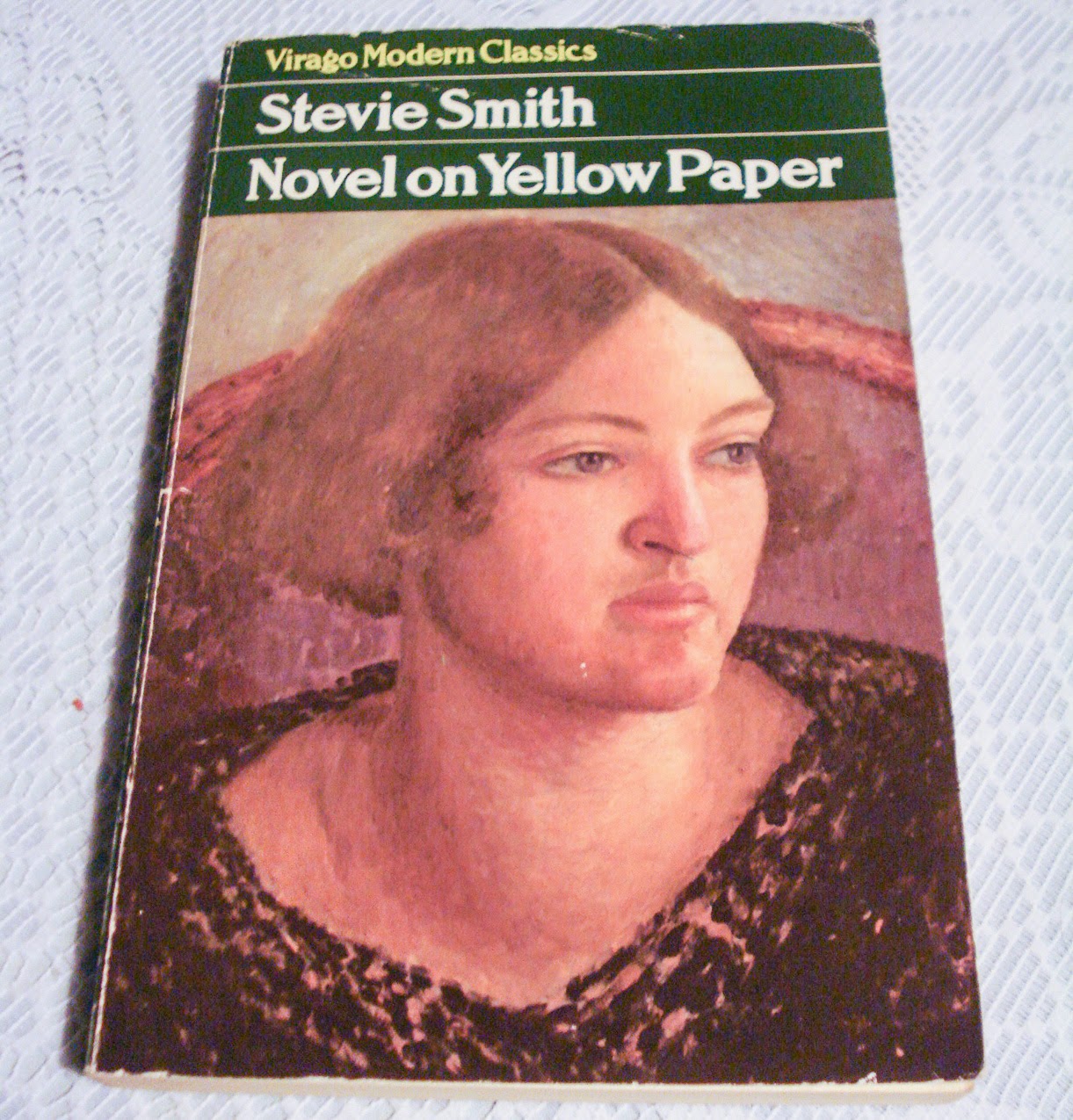 |
| This is one of the most extraordinary novels I've ever read - I just wish someone would republish it. |
Novel
on Yellow Paper, by poet Stevie Smith, is difficult to describe. It
is one of the most extraordinary novels I’ve ever come across. There’s no plot
or storyline, it doesn’t slot easily into of the usual pigeon holes, and the
central character is as hard to pin down as a will o’ the wisp, flitting from
thought to thought and scene to scene. I thought it would a difficult read, but
it wasn’t – it was like listening to someone talking, and I just loved it. I
think this should be republished, so everyone can read it.
Then
there’s STW, who can’t put a foot wrong as far as I’m concerned. She’s quirky,
slightly macabre, and very sly writer, who turns the world upside down in just
a few words. This is the tale of the Reverend Timothy Fortune, who ends up
on a remote tropical island where he converts one person – who turns out not to
have been converted at all! There are questions about the nature of belief, and
it’s very funny, but the humour is very dark indeed. And the notes about how
STW came to write this, and how she felt when it was finished, moved me to
tears.

