I
seem to have amassed a stack of gardening books, old and new, read and unread,
which I love

This
month, for example, in The Curious
Gardener, Anna Pavord begins by
suggesting I should trim my evergreen hedges and reshape the topiary: since I
have neither, I feel I can carry on reading with a clear conscience, unless I
can stir myself to tackle the buddleia, which are not evergreen, and are not
topiary, but they are striving for world domination, which is a problem in our
tiny garden. So, being a curious gardener, I’ve just looked these up, and
discovered I should have hard pruned them way back in March. So what do I do,
cut them right back now and hope they survive, or wait until next spring and
hope they don’t grow during the winter?
Actually
Pavord’s book is fascinating, with lists of tasks to be carried out each month,
and a selection of short essays on plants, gardens, and life in general. August
includes a moving account of how the ‘swoony’ perfume of sweet peas helped
recover from an operation for cancer, and a discourse on the lengths some
gardeners go to in a bid to attract butterflies to their plots. This last
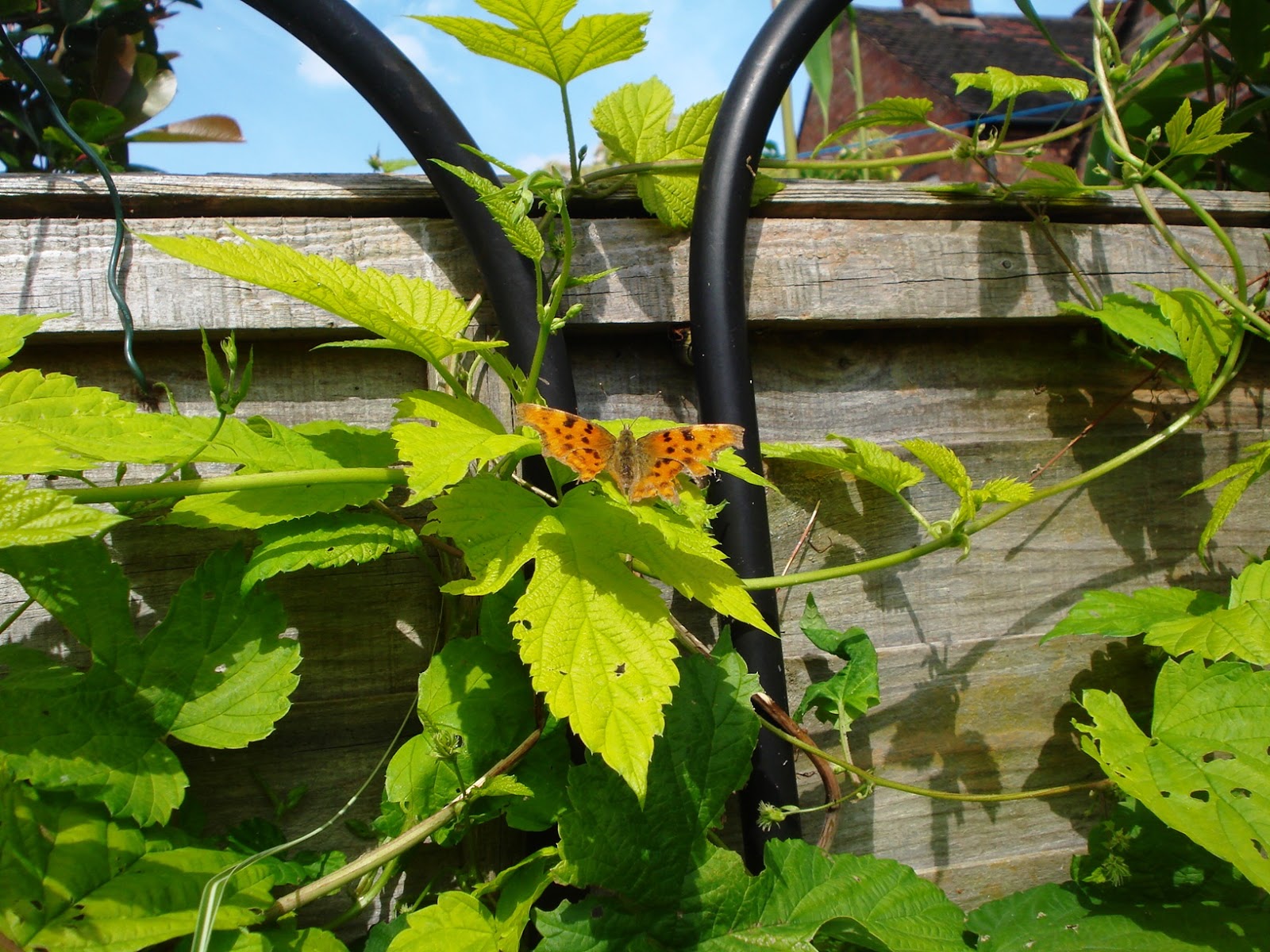
seemed a particularly apt choice of reading matter, since I spent a couple of
days recently spell-bound by the kaleidoscope of peacocks fluttering around the
dreaded buddleias, so maybe I’ll just let them be, because the butterflies are
so beautiful.
 Karel Capek, writing in The Gardener’s Year back in 1929, informs
us that: “August usually is the time when the amateur gardener forsakes his
garden of wonder and goes on leave.” He follows this with a detailed
description of the many and varied jobs that must be undertaken by the friend
of relative who is entrusted with looking after the garden. There is mowing to
be done, watering, staking and tying, weeding… and finding suitable spots for
the plants gathered by the absent gardener whilst on his holiday, and posted
home!
Karel Capek, writing in The Gardener’s Year back in 1929, informs
us that: “August usually is the time when the amateur gardener forsakes his
garden of wonder and goes on leave.” He follows this with a detailed
description of the many and varied jobs that must be undertaken by the friend
of relative who is entrusted with looking after the garden. There is mowing to
be done, watering, staking and tying, weeding… and finding suitable spots for
the plants gathered by the absent gardener whilst on his holiday, and posted
home!
But
Capek has serious points to make about our lives. According to him: “All year
round is spring, and all through life is youth; there is always something which
may flower. One only says that is autumn; we are merely flowering in other
ways, we grow beneath the earth; we put forth new shoots, and there is always
something to do.”
Capek
was a Czech playwright and novelist who, apparently, invented the word robot,
and I must read some of his fiction some time. Meanwhile I am enjoying his
gardening book immensely. It is easy to read, and is a light-hearted look at
gardening, which captures the joys (and the frustrations) of ordinary
gardeners, and the little line drawings which are scattered throughout (by
Josef Capek, who I assume was a relative), are an absolute delight.
 I
also took a look at the wonderful Katherine
Swift, who I’ve written about before. She is probably my favourite
gardening writer. I love her prose style, and the way she mixes information
about her garden with thoughts about life, medicine, herbal lore, ancient myths
and legends, history, geography, great gardeners of the past and all kinds of
other topics. The pieces gathered together in The Morville Year were all originally published in The Times, and
are informative and entertaining – a combination which is not always easy to
achieve. For August, you’ll find entries about raspberries, climbing plants,
summer pruning, dew, the dog days (so called because Sirius, the brightest star
in the sky, rises and sets with the sun at this time of year), and bees on
lavender. Did you know the Latin for
bumble-bee is bombus? The word, she says,’ perfectly conveys the sound - a deep
resonant hum – as well as their bumbling progress from flower to flower’.
I
also took a look at the wonderful Katherine
Swift, who I’ve written about before. She is probably my favourite
gardening writer. I love her prose style, and the way she mixes information
about her garden with thoughts about life, medicine, herbal lore, ancient myths
and legends, history, geography, great gardeners of the past and all kinds of
other topics. The pieces gathered together in The Morville Year were all originally published in The Times, and
are informative and entertaining – a combination which is not always easy to
achieve. For August, you’ll find entries about raspberries, climbing plants,
summer pruning, dew, the dog days (so called because Sirius, the brightest star
in the sky, rises and sets with the sun at this time of year), and bees on
lavender. Did you know the Latin for
bumble-bee is bombus? The word, she says,’ perfectly conveys the sound - a deep
resonant hum – as well as their bumbling progress from flower to flower’.
She
describes six different types of bumble-bee feeding on her lavender, including
the wonderfully named little lion-maned Carder bee, and the large red-tailed
bumble bee (they have red tails, like foxes, and ‘huge shiny black transparent wings
like glossy fifteen-denier stockings’). Unlike honey bees, bumble-bees don’t
store honey – the colonies die at the end of the year, apart from the young,
mated queens. I’d already decided that I’m planting to attract birds and
insects, and after reading this I’m even more determined. How could I resist
when there such are wondrous creatures in the world? For next year the
buddleias stay, and I’m planting lavenders alongside them, different species to
flower from May right through to the autumn frosts. And Swift says if you are
trying to encourage bees into a garden it helps if you are not too tidy, and I
am certainly not, so I’ve got a head start there!