Monday, 6 January 2014

Timbuktu: As far away as the Moon!

The Great Mosque of Djenné, which is in Mali 
(but not in Timbuktu, apparently, although the
building methods are the same in both places).
Courtesy of Wikitravel
When I was a child Timbuktu was one of those mysterious places that seemed to exist only in the imagination, like El Dorado, or Shangri La, impossibly far away, a city lost in time, hidden in the heart of the African desert, and it’s an image which has always fascinated me. When Nina Sovich was young her father told her Timbuktu was ‘like the moon… a nowhere place, at the end of the earth’. To her, it’s as far away as the moon, and the picture of a mythical, isolated city stayed in her mind, just as it did in mine.

But, unlike me, she actually got to see this city of dreams. She grew up, travelled widely, and worked as a war journalist. Then she fell in love with a Frenchman, got married, lived in Paris, and was a financial journalist. However, Paris and her ‘didn’t get along’ and she felt as if she had lost her soul, so, in a bid to regain her true self she set off for Africa and Timbuktu. It seems an extreme response, but once she’d been there she wrote a book, To the Moon and Timbuktu: A Trek Through the Heart of Africa, describing both her emotional and her physical journey.

Her goal was Timbuktu, or Tombouctou, once known as Timbuctoo or Timbuktoo. Is it just me, or does anyone else get confused by this constant politically correct renaming of places and people, like Mumbai instead of Bombay, or Boudicca for Boadacea? I know our knowledge of things has improved, and I’d be the first to agree it’s wrong that the British and other Europeans should have imposed their own names on the areas they colonised, but I’m so used to the ‘old’ names (even though they are really ‘new’, having ousted the originals) that I don’t recognise their replacements.

Anyway, Timbuktu really does exist, and Nina found it every bit as difficult and dangerous to reach as legend tells, for there was no road across the waterless desert sands, and no protection from the searing heat and burning winds. Actually, while reading this book (on the Kindle – can I still call it book?) I was reminded of CP Cavafy’s poem Ithaca, where the journey becomes more important than the destination. Towards the end, the poet tells us: 
Ithaka gave you a splendid journey. Without her you would not have set out. She hasn't anything else to give you. 
And that, it seems, is what happens. Nina is aware that the fabled city of myth no longer exists – if it ever did. In the 14th, 15th and 16th centuries, it was an important place on the trade routes through the Sahara. There was even a royal palace here, and rumours of the city’s wealth spread throughout the world, but they probably had little foundation, for the buildings were made not of gold, but mud, with protruding wooden sticks, so men could scale the walls to undertake repairs. However, Timbuktu had riches of a different kind, since it was a centre of learning, culture, and religion, with mosques, and libraries full of rare manuscripts.

Times change, and for 200 years or more the city was forgotten, until 1830 when Frenchman René Caillié became the first Westerner not only to reach it, but to make it home alive. He didn’t think much of the place, and Nina wasn’t too impressed either. She found a dirt-poor town, poised on the edge of war, which failed to provide the answers she sought. “The chance that I will find some new way of living in this town is remote,” she writes. But she admits:

I came to Timbuktu for the name, and now I too am burdening the town. I am bringing my baggage to this sunbaked end-of-the-road town and asking it to provide beauty and meaning, I am asking it to be something it is not.

The ambiguity of the place – ‘the floating sand, the rising heat, the blurred outline of a town’ – throw her off balance just a little, but it has an odd beauty. There’s the stillness of the old town, where buildings have been ‘baked into a kind of flaky crust’, and mosques have been softened by the rains until they look like ‘melting ice cream that was thrown into a freezer’.

Timbuktu, such as it is, is far-off and blurry, low-slung to the earth and constructed of hardened mud. It seems smaller and more piteous than other Malian villages, which at least have the Niger to ennoble them. Without the great river there is no definite outline to either to either town or the landscape that surrounds it. All in all, Timbuktu seems not unlike a mirage.

To get here Nina has travelled from Casablanca through Morocco, WesternSahara, Mauritania and Mail; by now she is exhausted, dehydrated and ill, but is in the grip of what amounts to an obsession with travelling. She has to keep going, and keep going she does, 300 miles further east to Gao, which is even more remote (as well as being even hotter) than Timbuktu. Travel is torture:

The dust in the air thickens again and visibility falls to almost zero. We pass through sheets of sand like sheets of rain, each hotter than the next.

In Gao she finally admits defeat. She’s had enough, she’s falling apart, and knows she must return home to find healing. Slowly she picks up the threads of her life, decides to have a baby then, when four months pregnant, returns to Africa, to travel through Niger. But this time she takes advice from her husband, stays in decent hotels, and eats properly. She also learns to slow down, and is content to sit and think, to enjoy the moment, to accept what life has to offer, letting the world come to her, rather than going out and confronting it.

She is, at times, extremely irritating in her desire to prove how tough she is, how independent, how feisty, how capable. Sometimes think she is struggling to show us what she is not, rather than what she is. She reminds me of Jeanette Winterson’s mother wrestling to hang out the biggest sheets in the windiest days, or my grandfather struggling to force life from the most barren patch of land. Some people, I think, are wired up to make life difficult for themselves.

For all that, it’s hard to dislike Nina, because she’s a very honest writer, who never glosses over her own feelings and motivations. And her accounts of the people she meets, and the landscapes she passes through, are fascinating. On her journeys she finds friendship and laughter, especially among women, who accept her and never judge, although her life and values are so different. I was surprised at the leading role played by some women in their family life, and the fact that they owned property, ran businesses, made decisions, and could in no way be regarded as second-class citizens. And I was also surprised at how the Islam faith was woven into the fabric of people’s lives in a way rarely seen with Christians.

Somewhere along the line Nina does find the strength to balance the conflicts within herself and her life. She allows herself to be ‘warrior and wife’, a free-spirited adventurer who craves solitude, but chooses to live with others. And somewhere inside she carries a piece of Africa, that she can call up in moments of need.

Sunday, 5 January 2014

Short Story Sunday: Treachery, Freedom, and Beauty!

This gorgeous screen printed furnishing fabric
is reproduced on the back endpaper of The
Persephone Book of Short Stories. It's called
Cote d'Azure,and was designed by Susan Collier
and Sarah Campbell for Fischbacher in 1983.

Oops! I forgot the title! And the intro! Sorry  - I will amend it now. Since this is Sunday, I have posted a Short Story Sunday piece, with brief notes on three of the tales. A kind of round-up, I guess. 

Spade Man from Over the Water, written by Frances Towers, starts gently with a conventional scene. Mrs Asher is taking tea with Mrs Penny (Laura) when a telegram arrives for the latter lady, saying her husband is coming home. Naturally she wants her friend and her husband to be friends. And what could be wrong with that? But a feeling of unease begins to build as Mrs Asher, with her dark eyes and waving hands (isn’t she a little too theatrical, I ask myself) looks at a photograph of a man she says looks ‘everything your husband should be’. On discovering the man is Laura’s cousin, Mrs Asher laughingly says: “I suppose you really married the Spade man from over the water!”
And at that point there is a definite sense that something is wrong, for Laura married Rupert, a dark stranger who keeps her isolated from friends and family, and although she is ‘wildly happy’ with him, she has a ‘queer feeling of disintegration’. And Spades are the cards which foretell doom and disaster... And Mrs Asher, whose husband Charles is also absent, is strangely silent when she sees a photo of the real Mr Penny, which is odd…

And Laura never does get to introduce her friend to her husband. The other woman’s house stands dark as the tomb, and an estate agent’s sign creaks in the wind. Treachery has taken place – but whose?

I loved this tale, with its building of tension, and the sense of unease. It’s almost like a ghost story, a haunting. And, as in so many of these stories (I keep saying this), there’s an ambiguity that keeps you guessing. At one stage I wondered if Mrs Asher is really ghost, but she is real enough I think, and I am sure she knows Laura’s husband. So are Rupert and Charles one and the same man? Did Mrs Asher steal Laura’s husband? Or is it the other way round, and has Laura, however inadvertently, stolen Mrs Asher’s husband?

Minnie’s Room, by the inimitable Mollie Panter-Downes, is one of my favourites from this collection. It is quite, quite superb. Here we have Minnie, who cooks for Mr and Mrs Southern and their grown-up children, Maurice and Norah. To all intents and purposes Minnie, an ‘ugly little Londoner’, is well looked after, well thought of, not badly paid, and quite happy. But she has always said she will leave service if she is not married by the time she is 45 – and that is just what she does. 

The family beg her to stay: they cannot understand why she wants a room of her own when she has a decent, comfortable room in their large house. But a room of her own is exactly what Minnie wants. She was independence, and she has been saving for years to make her dream come true. So she sticks to her guns, and tells Norah about the room she is renting, and how opposite the window is a lime tree which will smell lovely in hot weather. She even invites Norah to visit her and promises to make tea, with tea that will be kept in the antique caddy Miss Southern has presented as a parting gift.

And aging, spinsterish Norah, tied to her parents for ever more, envies the servant who has very little in material terms – but has found the freedom to live as she chooses, in a room of her own.

The English Lesson, by Margaret Bonham, is another of those quiet, understated tales where there is a little action, but which makes you think about the way we see each other, and how perceptions change, depending on your viewpoint.

Miss Maurer teaches English at a girls’ school. She seems rather ineffectual, is not particularly good at keeping discipline, and finds IVa especially trying (actually, trying doesn’t even begin to describe the behaviour of these supercilious little snobs). So, as some kind of antidote to the horrid girls, she decides that just for once she will have tea out, somewhere rich and warm. Which is how she comes to be spotted by Prue (from IVa) and her mother.

And this is where things get interesting. I’d visualised Miss Maurer as pale, dowdy and insignificant, Prue describes her as a ‘hag’, but Prue’s mother insists she is an unusually beautiful woman. At this point, since I hadn’t viewed Miss Maurer as being in any way attractive, I went back to the beginning and started reading again, searching for clues about her looks! I think my behaviour was the bookish equivalent of Prue and her friends, who spend their next English lesson staring fixedly at their teacher, which upsets her even more than their usual bad behaviour!
The design at the front of the book is taken from a roller-printed
cotton twill leave, manufactured at the Arnold Print Works,
Massachusetts, in 1911.

Friday, 3 January 2014

Hates, Highlights, and Loves....

Today I am listing. Not as in sinking ships, or leaning towers. No, I am talking about  producing ‘a number of connected items, names etc, written or printed together usually consecutively, to form a record or aid to memory’… so says my Oxford English Reference Dictionary, a reliable but weighty volume which provides invaluable advice about words. All of which is a long-winded way of introducing a compilation of my ‘Best’ and ‘Worst’ Books of 1913.  I know many of you have already posted similar pieces, but you know me, I’m invariably lagging behind everyone else, and it’s only January 3, so the New Year’s only just started.

I’ll start with my ‘Most Hated’ titles, and work my way up to the ones I loved, loved, loved, stealing bits from my original reviews along the way! And at the very end are two Bookish Highlights which made me happier than I can say. Anyway, books I didn’t like. On the whole I’m not very adventurous – I read for pleasure, and I tend to stick with books I think I’ll enjoy, so there aren’t many books that fall into this category, just four which failed to live up to expectations, and left me bitterly disappointed. There were others I didn’t rate very highly, but these the ones I didn’t like the most, if that makes sense.

Noel Streatfeild’s Ballet Shoes was one of my favourite stories when I was a child (indeed, I still read it from time to time), and I had high hopes of A Vicarage Family, the first volume in her fictionalised autobiography. However my hopes were dashed within a few pages. It was interesting to see how her childhood influenced her writing, but overall, as I said in my review, I felt something was lacking, and couldn’t put my finger on what that something was. I think it has to do with the fact that is not quite an autobiography, and not quite a novel: it falls somewhere between the two, and doesn’t quite come off. 

Jeanette Winterson is another of my favourite writers, and her biography Why Be Happy When You Could be Normal, is brilliant. But The Daylight Gate, about the Pendle Witches, is horrid, which is a shame, since she presented a fascinating programme about them on Radio 4.  Nothing pleased me about this novel and Winterson’s prose lacked its usual power and dexterity.

I bought Stella Gibbons’ The Matchmaker because I love Cold Comfort Farm, but this was tedious and irritating, and I struggled to finish it. But I persevered, even though there times when I could happily have hurled it across the room. It lacks the sparkle and wit of that first novel, as well as its charm and humour, and Gibbons seems to have lost her youthful disregard for literary and societal conventions.
Buying a book  because it has a
dancing penguin on the front is
a bad idea!
The worst book, without a doubt, was Mr Petre, by Hilaire Belloc. I was attracted by the dancing penguin logo, which I never can resist (I wish it was still in use). But it was a silly reason to buy a book, because this novel is truly, truly dreadful – I abandoned it in the end, and I don’t often do that with a book. All I can say is that it’s a forgotten novel that’s best left undisturbed. It sounded interesting, because the central character has lost his memory, and it’s supposed to be a satire on the world of finance, but it was so dull and boring, and the characters were flat and lifeless, so I gave up.

Now for the best of the ones I did like! I read so many good books this year it was quite difficult whittling them down to a manageable list – since there were four ‘hates’ I thought there should be four ‘likes’… Just to balance things out. But I didn’t quite achieve that!

A Month in the Country, by JL Carr, may be a slender novel, but it’s a perfect gem and anyone who loves quiet, understated, between-the-wars, English novels, where the focus is on thoughts and feelings rather than action, will enjoy it. The period feel was spot-on, the characters totally believable, and the writing absolutely faultless.

The Enchanted Places, by Christopher Milne (son of AA), was every bit as enchanting as the title suggests. It’s an autobiography which gives a fascinating glimpse into a vanished world. But it also shows how his childhood toys and games inspired his father’s stories about Pooh, and all those wonderful rhymes. But the creations, in turn, influenced the child. It was an almost symbiotic relationship and, for a time, Christopher hated the stories, but he comes across as being a remarkably well-adjusted adult.

I love this quirky and poetic book
I hardly ever buy new books, especially not hardbacks, but I made an exception for Things That Are, Encounters with Plants, Stars and Animals, by Amy Leach. I picked it up in a bookshop, started flipping through, just to see what it was like, and ended up sitting on the floor reading it! Since I couldn't stay there all day, I bought the book. It’s a series of essays on Life, the Universe and Everything, where Leach reflects on the natural world and makes observations which could just as easily be applied to people. She’s quirky (I like quirky), and attracted by oddities, and meanders from topic to topic, as one thing leads to another… and another… another… And she uses words like a poet, valuing them as much for their sound and rhythm as for their meaning.

Crime fiction isn’t usually one of my enthusiasms, but I loved A Red Herring Without Mustard, by Alan Bradley. This was my first encounter with child sleuth Flavia de Luce, who has many fans, and I can quite see why. If you’ve never read any of the mysteries featuring the 11-year-old prodigy and her trusty steed (a bicycle called Gladys) then I suggest you do so.

And I couldn’t resist including Baroness Orczy’s The Scarlet Pimpernel, which I hadn’t read for years and years. In theory it’s got little going for it. It’s certainly not great literature, it’s ideologically unsound and extremely biased (in favour of the aristos). But it’s such fun, and such a great read - I sat up into the early hours of the morning reading this, because I couldn’t put it down. It’s a real romp of a book, a love story and an adventure yarn, that could even be described as a mystery thriller I suppose.

Trailing just behind my Books of the Year are my tw0 ‘slow reads’ which I’ve been dipping in and out of during the year. The links are to the first post on each, which explains why I’m not racing through them in my usual fashion. If, like me, you’ve read many short stories, then The Persephone Book of Short Stories, would be a good place to start. I’ve had mixed responses to the tales – some I absolutely love, while others are not to my taste at all, but they all made me think.

Just ahead of this is Few Eggs and No Oranges, the wartime diaries of Vere Hodgson, which is brilliant, and has set me off reading all sorts of other things about the Second World War. Vere’s voice comes across loud and clear. She’s chatty and informative, juxtaposing major national and international events with the everyday and personal. It makes for fascinating (and compelling) reading.

This is one of the most extraordinary  novels
I've ever read  - I just wish someone would
republish it.
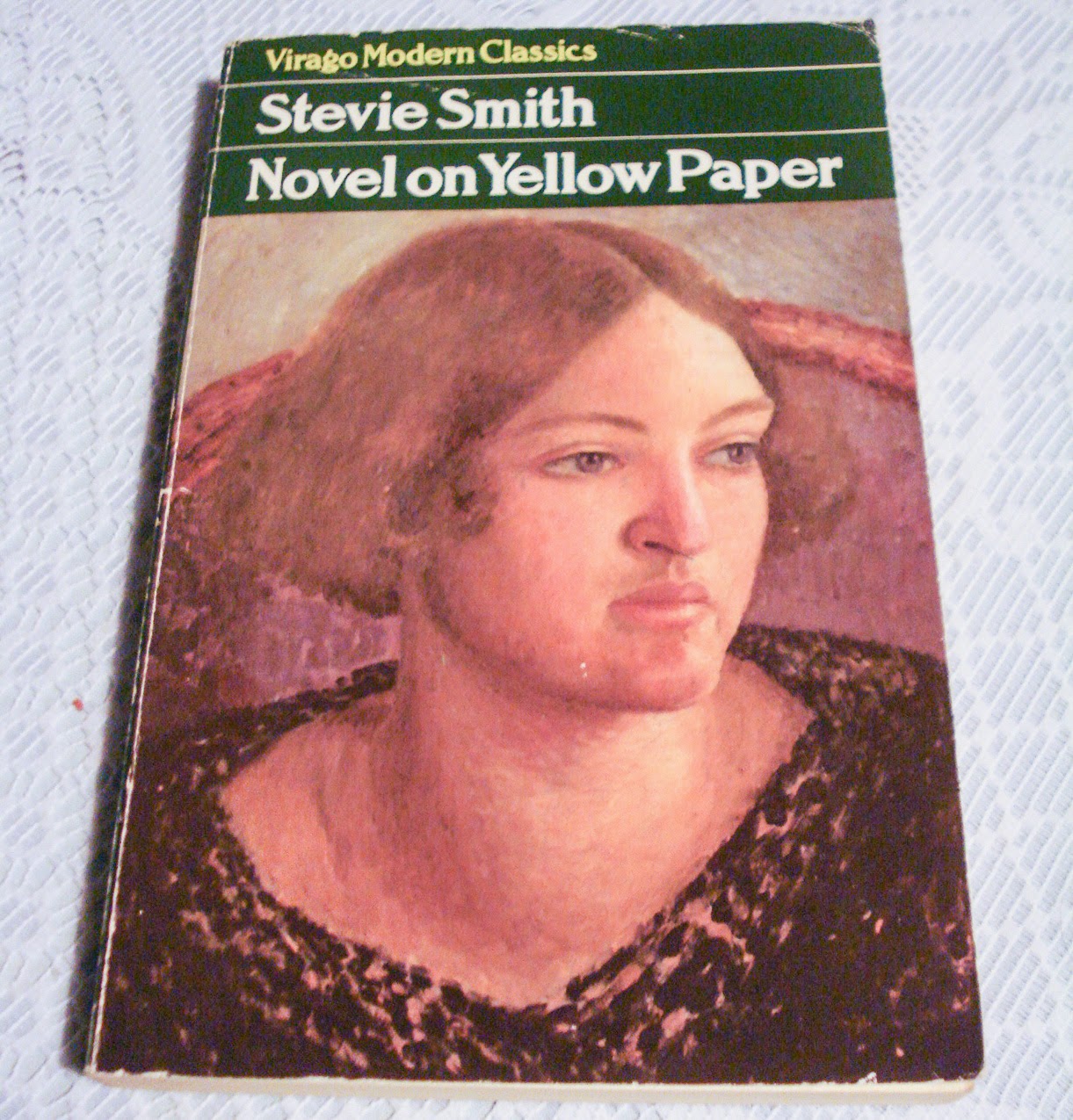
Joint honours for 2013 go to Novel on Yellow Paper, by poet Stevie Smith, and Mr Fortune’s Maggot, by Sylvia Townsend Warner, which were both absolutely outstanding.

Novel on Yellow Paper, by poet Stevie Smith, is difficult to describe. It is one of the most extraordinary novels I’ve ever come across. There’s no plot or storyline, it doesn’t slot easily into of the usual pigeon holes, and the central character is as hard to pin down as a will o’ the wisp, flitting from thought to thought and scene to scene. I thought it would a difficult read, but it wasn’t – it was like listening to someone talking, and I just loved it. I think this should be republished, so everyone can read it.

Then there’s STW, who can’t put a foot wrong as far as I’m concerned. She’s quirky, slightly macabre, and very sly writer, who turns the world upside down in just a few words. This is the tale of the Reverend Timothy Fortune, who ends up on a remote tropical island where he converts one person – who turns out not to have been converted at all! There are questions about the nature of belief, and it’s very funny, but the humour is very dark indeed. And the notes about how STW came to write this, and how she felt when it was finished, moved me to tears.

Finally, the Bookish Highlights!!! I was thrilled when Simon T, over at Stuck in a Book, asked me to take part in his My Life in Books series, and I had great fun putting a piece together about books that mean a lot to me (you can read it here). Then Jane and Briar, at Fleur in Her World, featured me in their Shall We Play (a Who Reads these Books quiz, answers here). I was so touched and pleased that Simon and Jane included me, as they both have a huge following, and are both much more erudite about books than I am. So another huge thank you to them both events (can I call them events?) are way up there in my Memory List for the year, along with my Surprise Birthday Treat, when my Daughters took me to Oxford for the day! And a huge thank you to everyone who has read and commented on my somewhat erratic posts - I write for myself, but it's so encouraging, and so rewarding to get such a positive response. Please keep reading!

Wednesday, 1 January 2014

Spellbound by a Sparkling Story!

Happy New Year people! I’m still here – I haven’t gone anywhere, and I certainly haven’t given up blogging. But I cannot believe I haven’t posted anything since the middle of November, and I haven’t really got much of an explanation. I’ve been trying to get ‘social media’ stuff up and running for Oxfam Lichfield, and I’ve been focusing so hard on that, it seems to have squeezed everything else out - I even wrote an Advent Alphabet, highlighting things in the shops and the charity's work. Here's the rhyme for 'H' on December 8. 
For warmth when it's cold
Or shade in the Heat
A Hat on your Head
Makes an outfit complete.

And it was the anniversary of my Father’s death, which always gets me down, and then I don’t feel like doing much. And it there was the run-up to Christmas, and New Year, and my Mother has been to stay, and my Daughters visited, with their boyfriends, and I had a lovely time over Christmas, but The Book Trunk got a bit forgotten! 

Now it’s January 1, and I’m trying to organise myself for the year ahead… Back on the diet, lots of walks planned, crochet and sewing to finish, lists to write – you know the kind of thing. Anyway, Oxfam Lichfield’s Facebook page is doing quite well after being ignored for ages because no-one had any time to do anything with it. It’s generating ‘likes’ and a few comments, and almost runs itself. I take photos, and write little bits, then schedule them to appear. Scheduling is like magic I’ve decided, because you can do masses of stuff in advance, then more or less forget about it all – I should use it more here, and it might stop me getting behind! And I wish I could use it on Oxfam Lichfield Twitter, I’m sure it would make life easier – when I’m stuck, then whatever the weather I tell people it’s ideal weather for buying books! The weather can never be too bad or too good for buying books – wouldn’t you agree?

And I’ve set up a blog for our two Oxfam shops. It’s in what can only be described as an embryonic stage, but I’ve got posts scheduled to appear, someone cleverer than me is going to work on the design and, hopefully, it will gradually acquire its own identity. So you can see, I really have been busy, and haven't been idling my time away.

Anyway, this is supposed to be a book blog, so I shall stop wittering on about my volunteering project, and enthuse about a book – Loitering with Intent, by Muriel Spark. With the exception of The Mandelbaum Gate, which I wouldn’t read again even if you paid me, I just love Spark’s novels, and this is one of her best – way up there with my favourites, The Ballad of Peckham Rye, and The Girls of Slender Means. 
Spark doesn’t do heroines – she doesn’t do heroes of villains either – but Fleur Talbot is as near a heroine as you’ll find in Spark’s work. Fleur takes a mysterious job as secretary to Sir Quentin Oliver, who is the director of the Autobiographical Association, a very peculiar organisation whose idiosyncratic (positively batty even) members are compiling their memoirs, but no-one has got beyond the first chapter. They’re hampered by dodgy memories and lack of talent, and it falls to Fleur to try and make sense of their efforts .

She herself is writing a novel, Warrender Chase, which Sir Oliver steals, and somehow life and fiction become strangely and inextricably mixed as things Fleur believes she has created in her story actually happen, and it becomes more and more difficult to tell what’s real, and what’s not, and you start to wonder is Fleur a reliable witness to events – or is the whole mad, chaotic story spun out of her imagination.

Actually, Fleur reminds me a little of Pompey in Stevie Smith’s Novel on Yellow Paper – I know I said you are unlikely to ever read anything quite like it, but I hadn’t read this then, and quite apart from the fact that Pompey is writing a novel while she works as a secretary for publisher, there is something in these characters’ outlook on life, that is similar, and the way they stand back observing things and people.

I assume Fleur is based on Spark, and her thoughts on writing fiction and the creative process are, presumably those of the author. As in much of her other work, Spark raises issues about the nature of reality and fiction, belief in God, immortal souls, love, death, truth and lies. None of the characters ever quite connect with each other, and they all seem to have shaped their own little worlds from their own realities, but none of the realities fit together – and in any case does anyone ever know what truth really is. Loitering with Intent is darkly funny, very witty, beautifully written in classic Sparkling style, and held me spellbound from start to finish. How could anyone not like a book which opens like this:

One day in the middle of the twentieth century I sat in an old graveyard which had not yet been demolished, in the Kensington area of London, when a young policeman stepped off the path and came over to me.

And if you think that sounds gentle, then beware, because Spark is never gentle, and never safe. She’s wickedly funny, but she’s sharp and spiky and can be very unsettling indeed as she probes below the surface of polite society and turns the world upside down, and at the same time she poses those big questions about life, the universe and everything.

Sunday, 17 November 2013

Mother and Child Reunion

It’s been a while since I’ve posted my thoughts on any tales from The Persephone Book of Short Stories, but I certainly haven’t forgotten them. So here’s are two for this week’s Short Story Sunday. You’ll find there is a kind of loose theme, or link, in that both today’s tales explore the failing relationship between mother and child during a reunion.

Elizabeth Berridge.
Subject for a Sermon, by Elizabeth Berridge, studies the relationship between Lady Hayley and her son John, and the conflict between tradition and duty, and an individual’s independence. It is set in 1944 and opens as Lady Hayley addresses the Guides, on behalf of the Red Cross – on the very night her son is due home on leave. As her train pulled out, we are told, his train pulled in. And she must catch the early train next morning, because she has a meeting a meeting at noon, and John will understand.

Everyone thinks Lady Hayley is marvellous, for doing so much, and putting duty before her family, but she reminds me of EM Delafield’s monstrous Charmian Vivian, Director of The Midland Supply Depot in The War Workers. They are both overbearing women who have created an image of themselves as busy, selfless workers which is at odds with the hollow central core within. And there are moments when you sense the faith of Lady Hayley’s adoring fans is shaken, and they query her motives. Miss Pollett, from the Guides, for example.

… she had a strange feeling that if the other coffee cup had not been on the table, the cap beside it, she could have believed herself alone in the room. And to allay the disturbing feeling that she could never get past that quick smile – to prevent it pushing her away – she asked about the morning train.

For Lady Hayley her duties, especially in war, are everything, pushing personal feelings, family and her own likes and dislikes into the background, and she cannot understand John, whose outlook is very different, and she tells him:

Always you see things in the wrong perspective. There are many things I do not like doing – Miss Pollett frays my nerves, I dislike long journeys made in uncomfortable circumstances, I am nervous when on a bicycle. But if I did not do these things, who would? It is expected of my position – our lives are not our own John.

But John believes she is wrong, and that she should let people organises their own schemes. And he realises she doesn’t really care about people, doesn’t want to know them and wouldn’t recognise them if she met them again. She’ll talk to them to raise money for the war effort, but she’s only interested in maintaining her own position, he says, and seeing that other people keep to their place.

I’ve lived among them, mother. I know what they think about people like us. I know what they’re like, and what they want – and it’s nothing we represent. We’ve had our chance as leaders of society, and lost it.

He can see that the world is changing, but I think the thing that angers and distresses him most about his mother is not her values, or moral code, or political views, but the fact she seems to have as little interest in him as she does in anyone else, and ignores him while administering to the needs of thousands of unknown men, and it’s this which causes the impasse between them.

During his visit Lady Hayley continues her relentless round of meetings, but she keeps the afternoon and evening of his last day free. However, it’s a gesture which comes too late, for he leaves earlier than planned, to meet an Army friend. The two part still unable to understand each other, and Lady Hayley pedals off to a meeting where, as usual, she preaches at her audience, telling them that in war women must be companions, mothers and organisers, and how this involves sacrifice, loss and pain. She stresses the need for solidarity and tells the women she feels ‘so much at one’ them… and once again we find Miss Pollett wondering, and wishing Lady Hayley really means it.

I hadn’t come across Berridge before, but apparently Persephone also publish Tell It To A Stranger, her collection of short stories, and she also wrote nine novels, which were very popular in their day.

Wednesday, by Dorothy Whipple is an old favourite – it’s in The Closed Door, an
Dorothy Whipple
anthology of her short stories put together by Persephone, which I reviewed here and, should you wonder, I know this post is beginning to sound like a promotional piece for Persephone, but they do publish some exceedingly good books, and I do read lots of books published by other companies.

In Wednesday we meet divorced wife Mrs Bulford (she still refers to herself by her married name) paying her monthly visit to her three children, who are already beginning to forget (and, possibly, to resent) her, and are forming allegiances to their new ‘mumsie’, for their father has remarried.

She waits for the children outside the garden wall, and we learn that she is an outsider in every sense of the word, shut out from the home and family that were once her’s, and shut off from respectable society. For Mrs Bulford, ‘on the verge of middle age’ went ‘gallivanting’ with a younger man. When the affair was discovered her young lover’s family took him abroad, her husband (who she believes pushed her into adultery) divorced her, and she was deemed neither fit to proper to care for her children. Now, lonely and friendless, with nothing to do to fill her time, she cannot understand what has happened to her, and still harbours a forlorn hope that one day she will be able to walk back into her old life.

She was like an exile waiting all the time to go home, devouring news of the place she longed to be in. She bought the Beddingworth papers, morning and evening, and read every word, even the advertisements. She knew who was born and who died or was married, she knew who wanted domestic help or houses.

She knows more about the city and its people than she did when she lived there. What she doesn’t know is what her children are doing, how they are growing and changing, what they like and don’t like, and how they feel. But as she stands waiting to meet them she imagines them inside their house, eating their lunch. She takes to them to the park, and treats them to afternoon tea, but the relationship between mother and children is uneasy, and they are growing away from her – indeed, they are pleased to be reunited with their father and ‘mumsie’. As they disappear from view Mrs Bulford cannot bring herself to pass the house.

But later when the dusk was deeper, she passed it on her way to the bus. Elsie had just come out to pick up the hoop on the lawn. Upstairs someone was drawing the curtains, first at one window, then at another. They were all gathered in for the night. Everything was very quiet. Even from the gate she could smell the sweet peas. She walked away down the road.


Mrs Bulford may be a very silly woman, but it is a touching and beautifully written tale, and it’s hard not to feel sorry for her watching life carrying on without her. Whipple’s writing is so understated – she really does ‘show not tell’ and doesn’t go in for big emotional scenes, but the details of the routine of family life are so perfect, right down to the perfume of the sweet peas, and it all highlights Mrs Bulford’s feeling of loss. 
The endpaper at the back of the book is
Cote d'Azure, a scree- printed cotton
furnishing fabric designed by Susan Collier
 and Sarah Campbell for Fidchbscher.