Showing posts with label cooking. Show all posts

Friday, 26 June 2015

Cures For 'Gardening Hands'

It’s June, and the year is half gone, so I think it’s time we took another look at Mrs CW Earle and discover what advice she has on offer for the month in her 1897 lifestyle guide, Pot-Pourri from a Surrey Garden (you can see my original post here).
 
In the late 19th and early 20th centuries glycerine was regarded
as something of a wonder cure for skin ailments, and to keep
hands and skin soft. This advert dates from 1914.
(Pic from Cosmetics and Skin)
She starts with her thoughts on looking after your hands. She tells us:

It must admitted that one of the great drawbacks of gardening and weeding is the state into which the hands and fingers get. Unfortunately, one’s hands belong not only to oneself, but to the family, who do not scruple to tell the gardening amateur that her appearance is ‘revolting’.

She advocates constant washing of the hands, and recommends the ‘never-failing’ use of Vaseline to keep them smooth and soft. Actually, I’m not at all sure I’d want to smear my hands with Vaseline, because it’s horribly thick and sticky, and it wouldn’t be absorbed into the skin nice and quickly, like modern hand creams. Surely you’d leave sticky, greasy marks on everything you touched. Anyway, Mrs E offers an alternative which, she says, is even better – a mixture of glycerine and starch, kept ready on the washstand after washing and before drying the hands. I assume the starch would have been the old-fashioned laundry stuff, presumably in plentiful supply when the book was first published.

She also informs us that old dog-skin or kid gloves are better for weeding and many other tasks than ‘so-called’ garden gloves. And housemaids’ gloves, made from wash-leather, and available at any village shop, were ‘invaluable’ for ‘many purposes’.   

Wash-leather, I think, was what we used to call ‘shammy’ (or chamois) leather when I was a child. I seem to remember it was yellow, good for cleaning windows, and polishing metal, and could be used wet or dry, and washed and dried when it was dirty. In Victorian and Edwardian times housemaids wore wash-leather gloves, so I guess they were a precursor of today’s rubber gloves. Presumably they offered some protection for the hands, and also ensured maids didn’t leave grubby fingerprints on furnishings and surfaces!
If you followed Mrs Earle's advice, you'll have a good crop of
strawberries ready just in time for Wimbledon. Sadly, I didn't, so
I'll have to buy some to eat while I watch tennis on TV!
(Pic from BBC Good Food)
Anyway, June in the garden means strawberries,  and Mrs E explains:

For many years this fruit was poison to me; now it gives me pleasure to think that I live almost entirely upon it for some weeks in the summer, eating it three times a day, and very little else, according to the practice of Linnaeus, as quoted in March’

In growing strawberries, everything depends on making some new rows every year; layering the runners early, too, makes a great difference in the young plants the next year.

She also mentions that Dainty Dishes (her cookery ‘Bible’) has instructions for old-fashioned ‘receipts’ for strawberry jam – but, alas, she doesn’t share them with us! However, she gives us a selection of other recipes. Apparently, a mayonnaise soufflé of crab is ‘rather out of the common’ or a summer luncheon. It’s very much of its time, involving buttered paper inside the liner of a dish, seasoned crab, whipped aspic jelly, mayonnaise sauce, fried breadcrumbs and an icebox.

But never fear, there’s a ‘less complicated’ luncheon dish (does anyone still prepare ‘luncheon’ dishes I wonder):

Take some ripe tomatoes, equal-sized; cur a round hole and scoop out a portion of the middle, fill in with cold minced chicken and Mayonnaise sauce, put some aspic in the dish, and serve the tomatoes on pieces of fried bread, cold.

Life, as Shirley Conran said, is too short to stuff a mushroom, and I reckon the same thing could be said for tomatoes!
Cucumbers: Has anyone ever tried cooking them?
(Pic from Wikipedia)
In addition Mrs Earle instructs us in the art of making chutney, cooking crisp cauliflower - and cooking cucumber, which sounds odd, since we eat it raw in salads. Here you’ll find three different methods for serving cucumber hot, and I suppose it’s not really any different to cooking marrow or courgettes, just a little more watery perhaps. I’ve ignored her first two suggestions, but here’s the ‘receipt’ for the third:

A third way is to take a large old cucumber, peel it, cut of the two ends, and boil it very lightly. When done, make an incision down the middle, not quite to the two ends, scoop out the seeds, and fill the hollow with a light stuffing of suet, herbs, breadcrumbs, and egg. Serve it whole, like a roly-poly, with a yellow Dutch sauce around it.

I’d never come across yellow Dutch sauce, but it turns out to be hollandaise sauce, so the clue was there in the name. I’m tempted to try it, but with a different stuffing, but I’m worried the cucumber might disintegrate!

Wednesday, 6 June 2012

Do You Clean Vegetables With Soap?

Today's novel was described as 'a real oddity' and 'a book unlike any other' when it was discussed on the Radio 4's 'A Good Read'. House-Bound, by Winifred Peck, (published by Persephone), is the second in my loosely-themed 'housework' quartet. The time is 1941, the place is Edinburgh, and middle-class, middle-aged Rose Fairlaw, unable to get servants, decides she will do the cooking and cleaning herself.

My initial reaction was that Rose needed a copy of 'How To Run Your Home Without Help', by Kay Smallshaw (reviewed here), but this wonderful and invaluable domestic guide was was not available until 1949, while Peck's book was published in 1942. Anyway, it was selected for the radio programme by author Sara Maitland, who described it as 'a bit of oddity' (albeit a 'rather good' one) and 'one of the weirder novels I've ever read'. Fellow guest Michael Morpurgo and the show's host Harriet Gilbert both agreed. You can listen to their discussion here, and can also read a transcript of their conversation in the latest edition of the Persephone magazine Biannually.

Personally, I'm not sure I agree with everything they say, because the book is actually not that odd (certainly not compared to Rachel Ferguson's 'The Brontes Went to Woolworths', which remains the strangest story I have read). Granted, the relationships are a little peculiar, but relationships in novels are rarely straight forward, creating tensions vital to the plot, developing characters, and demanding an emotional response from readers. I think what they found so weird was the lifestyle, social setting, and moral code of the day. Time and place can be difficult to grasp when they are so different to your own life – I'll bet Jane Austen's concerns about social position and marriage must appear pretty incomprehensible to many people these days, but no-one describes her books as weird or a bit of an oddity.
The beautiful endpapers in this Persephone edition are from
a 1941 watercolour by Eric Ravilious for a textile commissioned
by the Cotton Board to persuade manufacturers to produce
 economical fabrics during WW2
Oh dear, this is turning into a rant about other people's views on 'House-Bound', rather than a piece about my own opinions. So here goes. I'll start by saying that Rose is not one of those self-deprecating women who cope with domestic disasters, house, husband, servants, children and tradesmen with good-humoured aplomb. She has a sense of duty, whether you're talking about relationships or housework, and she regards managing without servants as her contribution to the War Effort, freeing up younger, fitter, more able women for more valuable war work.

The reaction of her family and friends to her decision is hilarious, even if they do show the values of the strong, snobbish class system in force at the time. And her early efforts at housekeeping are very funny indeed. When it comes to cooking and cleaning she doesn't have a clue. She's never boiled a kettle, let alone an egg, has never wielded a duster – and has certainly never been expected to answer the door and deal with common people like postmen and milkmen.

It's a real shock to her system. “On the first morning of her new vocation Rose decided that she had never in her life seen anything as repulsive as a house in the early morning.” I know the feeling. I find if there's anything worse than dealing with household debris and dirty dishes, it's dealing with household debris and dirty dishes that have been left to fester overnight. The answer is to de-clutter and wash-up before going to bed but, sadly, this is something I rarely do.

Winifred Peck
And anyone who has ever lost the battle with a less than perfect vacuum cleaner will appreciate Rose's struggles: “Sweeping was easy she told herself as she rumbled the carpet-sweeper up and down the beige self-coloured carpet of the dining room [...] the wretched thing seemed to drop out a loathsome gobbet of grey fluff more often than it picked up a crumb.”


She doesn't know how to clean vegetables (does one use soap, she wonders), and her first breakfast is a disaster - the coffee boils over the bacon and toast and makes the stove brown, so Rose's husband Stuart eats sardines! Luckily for her, she is rescued by Mrs Childe, who knows everything there is to know about cookery and housework (and some!), and puts in three hours a day, working, and teaching Rose how to do things herself. And there is additional advice from Major Hosmer, a charming young American army psychologist who, coincidentally, turns out to be treating Rose's troubled daughter Flora.


However, despite the laugh-out-loud funny passages, this book is not a comedy. There is tragedy here, and serious social commentary. Rose has little time to reflect on politics or religion (beyond huried prayers begging God to protect those she loves) but she knows the world is changing. She feels house-bound, tied to her pots and pans, and sees the connection between this and the wider world. The word house-bound, she says: “... belonged not only to herself, not only to Martha in Bethany, but also, surely, to all the unhappy individuals and races all over the world. Peoples, countries, empires, shut themselves up in their own domains, refusing to consider the views on which others gazed from their windows...”


I haven't looked at the other characters or the relationships in this novel, but I will mention the back story. Rose marries and has a daughter, but her husband is killed in the First World War, while Flora is just a baby. Rose's best friend, her cousin Lilias, moves in with her baby son Mickie, while her husband is fighting. The children are brought up together, but Lilias dies from pneumonia, so Rose cares for Mickie, becoming obsessively fond of him. When Lilias' husband – Stuart Fairlaw – returns, he marries Rose, because they are both lonely and can comfort each other and make home for the children. 

Since I bought the book second-hand, there was
no bookmark,  so I printed off this picture of
Woman Reading, painted by Adrian Paul Allinson
in 1940, because it kind of how I imagine Rose
(although she is  dark, not fair) and
her home, and she loves reading
They have a son, Tom, but the marriage is passionless. The one overwhelming love of Rose's life seems to be Mickie, and when he falls ill with polio she shuts herself away to nurse him. When she emerges, two years later, he is cured, but her relationship with Flora is irretrievably damaged, and her chances of growing closer to Stuart are doomed.


It's not until the end of the novel that Rose looks back and remembers her first husband, and the hopes they had for Flora, and is able to reach a kind of acceptance of what life has to offer, and to move on. But she is still bound by duty and doing the right thing. She will continue to do what she must, remaining slightly aloof from everyone and everything. I get the feeling that underneath is a different kind of woman who is too scared to struggle free – someone who would like to flirt, and dance, and have fun.

House-Bound is one of those novels you could read over and over again, looking at different aspects. One last point (well, two really), Peck was obviously amazingly well-read, because House-Bound is jam-packed with literary references, (many of them unattributed), and there is an interesting Afterword by her niece, the novelist Penelope Fitzgerald. 

Friday, 24 February 2012

Cupcake heaven - stitched and baked!

And now for something completely different. Cup cakes! I have been making edible and non-edible varieties. The ones intended for consumption came courtesy of a recipe in The Hummingbird Bakery Cake Days: Recipes to make every day special, by Tarek Malouf, which I came across when I visited a friend who had been given a copy for Christmas. It really is a beautifully produced book, with wonderful pictures, and some lovely ideas for cup cakes, muffins, and something called whoopie pies, which I hadn’t encountered before. Conversation came to an end while I copied some of the recipes and sampled her Coca Cola cakes.
My cup cakes - next time I'll use a recipe from an old book.
 Today I finally had a go myself and the cakes are wonderful, but the icing was too runny, so I added more icing sugar, and it ended up much too sweet and not the right texture, so I tried piping it on to the cakes, to see if it improved matters, but it didn’t.  Anyway, I topped them off with carob-coated raisins rather than the suggested Coca Cola sweets, and I am sure they will get eaten. 
The '50s housewife decorating her version of
of cupcakes (from the Good Housekeeping
Cookery Compendium)
And lovely though the Hummingbird book is, some of the recipes look a bit fiddly for what my mother scornfully refers to as  jumped-up fairy cakes, and I haven’t even tried her with whoopie pies, which appear to be a variation of the sponge drops she used to bake for my brother and I, sandwiched together with buttercream or home-made jam.  
Sponge drops : were these an early form
of whoopie pie? (from the Good Housekeeping
Cookery Compendium)
Anyway, I’ve ended up sitting reading the Good Housekeeping Cookery Compendium, published by Waverley in 1954, when my grandmother bought it as a present for Mum, and she gave me when my father died. It may not have the allure of modern celebrity cookbooks, but it’s packed with basic information; fool-proof, fail-safe recipes, and scores of pictures, including some in colour, and it’s one of the books I fall back on time and time again when cooking.  It’s not just the recipes that I find so appealing, but the association with childhood. As I turned the tattered pages today I swear I could smell ginger biscuits baking in the oven, and egg curry on the stove! And it made me recall my very first efforts at cooking, when I was so small I had to stand on a chair to reach the kitchen table – and the evidence of a terrible accident involving an egg can still be seen on the opening pages of the section about small cakes (queen cakes, assorted kisses, honey buns, melting moments and chocolate cakes).
Children's sponge cakes also seem similar to
modern whoopie pies.  (from the Good Housekeeping
Cookery Compendium)
Oddly enough, a pristine copy of the book was recently donated to Oxfam Books and Music, in Lichfield (where, as I’ve said before, I am a volunteer) and I did wonder if it was time to replace the old copy, but it wouldn’t be the same because it wouldn’t have that connection with my past.
A plate full of goodies. Tiny 'bottle-top' muffins, and
colourful cup cakes - actually they look more like those
whoopie pies, which really intrigue me - it's such an odd name.
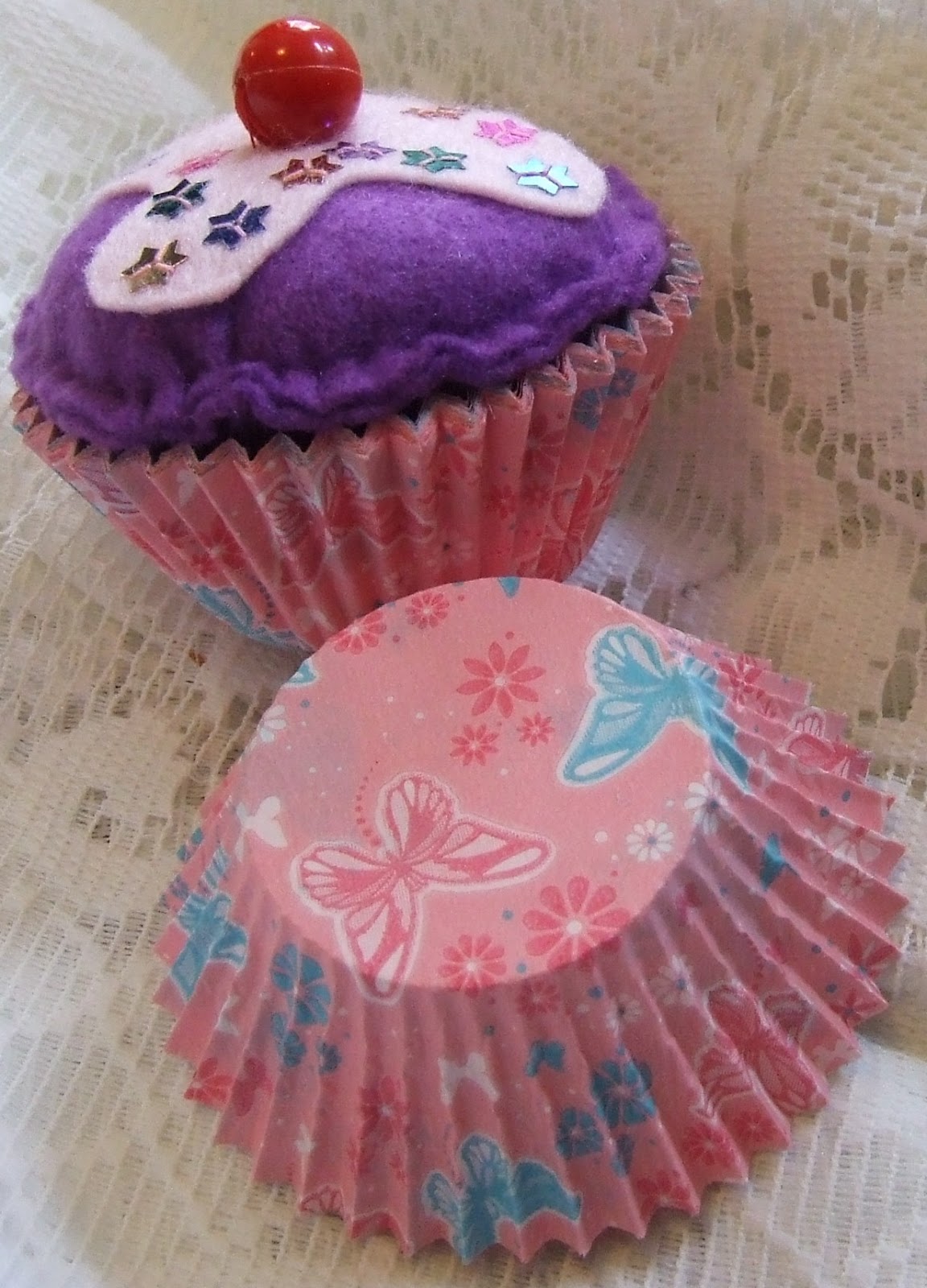
And talking of Oxfam leads me to the non-edible cupcakes. I have been stitching them in pink and purple felt, as requested by a fellow volunteer who is also busy sewing. Decorated with beads, buttons and embroidery, they will make the window look decorative for International Women’s Day on March 8 – and we also hope to sell a few (they make nice pincushions) and boost Oxfam’s funds.
Balancing act! Put a felt cupcake on a cake case
and it looks quite eye-catching.
The charity aids women all over the globe by helping to improve education and maternity care. It also provides support for women to establish businesses in their community, so they can provide better opportunities for their children – details about the work being undertaken can be found at http://www.oxfam.org.uk/womensday?pscid=ps_clk_IWD+2012